Nicaraguan civil society and international experts call for a new Human Rights Council resolution to address the crisis in Nicaragua
Washington, D.C., February 18th, 2021.– As the United Nations Human Rights Council prepares to open its 46th period of sessions, representatives of Nicaraguan civil society, including victims of human rights […]
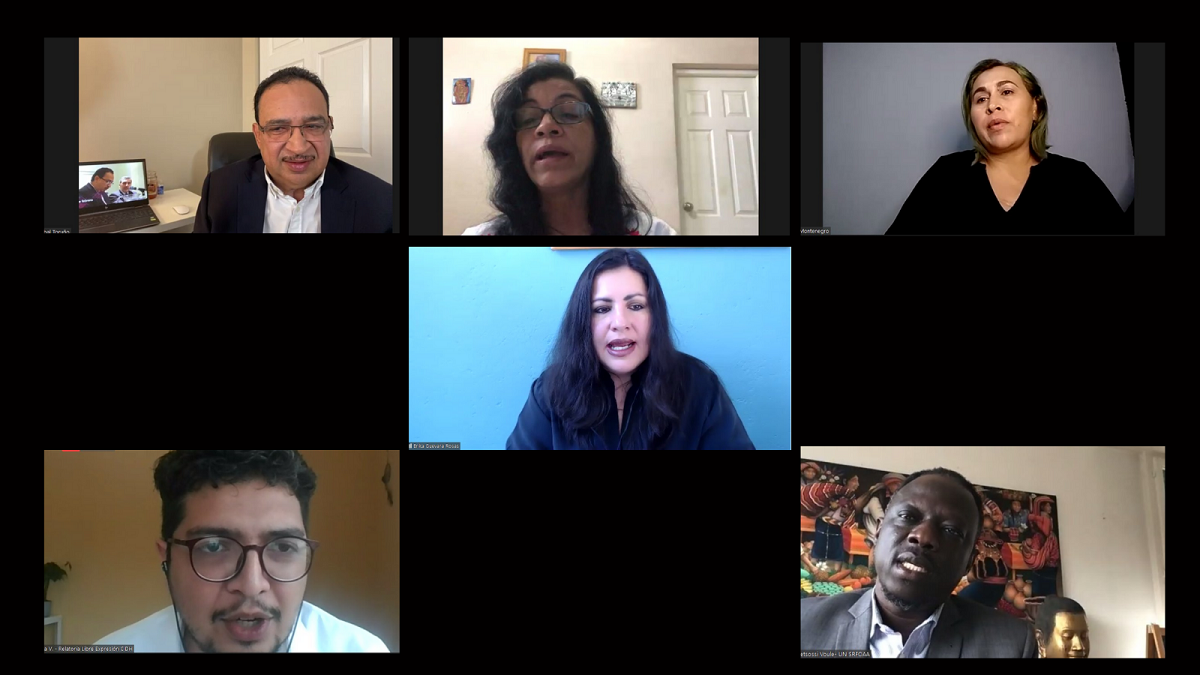
Washington, D.C., February 18th, 2021.– As the United Nations Human Rights Council prepares to open its 46th period of sessions, representatives of Nicaraguan civil society, including victims of human rights violations, joined international experts from the UN and the Inter-American Commission on Human Rights (IACHR) to urge the Council to approve a resolution strengthening High Commissioner Michelle Bachelet’s mandate to monitor Nicaragua’s human rights crisis.
The event “The role of the United Nations Human Rights Council in the face of the continuing human rights crisis in Nicaragua” included the participation of Thelma Montenegro, family member of two political prisoners and four people killed in the context of the repression unleashed by the social protests of April 2018; Lottie Cunningham, founder and president of the Center for Justice and Human Rights of the Atlantic Coast of Nicaragua (CEJUDHCAN); Aníbal Toruño, director of Radio Darío and victim of constant police raids on his home and radio headquarters; Clément Voule, Special Rapporteur on the Right to Freedom of Peaceful Assembly and Association of the United Nations, and Pedro Vaca, Rapporteur for Freedom of Expression of the IACHR. The moderator was Erika Guevara, Director for the Americas of Amnesty International.
Context
UN High Commissioner for Human Rights Michelle Bachelet will present her report on the human rights situation in Nicaragua during the upcoming session of the Human Rights Council (February 22-March 23). Twelve Nicaraguan and regional organizations, among them the International Institute on Race, Equality and Human Rights (Race and Equality), organized the virtual panel event to update attendees on the ongoing human rights violations in Nicaragua and to emphasize the importance of renewing and strengthening the High Commissioner’s mandate.
The Montenegro Family
Thelma Montenegro took part in the panel to expose the persecution, criminalization, and violence that her family has suffered for participating in the protests of April 2018. “Our participation unleashed hate, persecution, and cruelty on the part of the government’s supporters,” she said, revealing that since the protests, four of her family members have been killed, among them her two brothers Oliver and Edgar Montenegro and her husband Francisco Blandón.
Ms. Montenegro also shared that two of her nephews remain in prison as a consequence of their beliefs. Oliver Montenegro Muñoz, who was detained on June 21, 2020, was sentenced to 10 years in prison for the supposed crime of attempted homicide. Dorling Montenegro Muñoz, detained November 30, 2020, is charged with obstruction of justice, illegal possession of weapons, and attempted murder.
“We ask for monitoring and decisive action towards our country…We are in an election year, and now is the moment of opportunity to change our history, so that all this suffering does not repeat itself,” she stated.
Violence and vulnerability in the Northern Caribbean
In her presentation, human rights defender Lottie Cunningham stated that Nicaragua’s closing civic spaces and weakening democratic protections are causing displacement and systematic violence against indigenous peoples and those who defend their rights. In 2020, she stated, 13 indigenous Nicaraguans were killed, 8 were wounded, 2 were kidnapped, and at least one community was displaced from their territory. Since 2011, 49 indigenous people have been killed, 52 injured, 46 kidnapped, and 4 disappeared.
“As a result of this violence, it is estimated that 3,000 individuals from the Miskitu people alone have been forcibly displaced from their communities, including in the Honduran border region,” Ms. Cunningham explained, reporting that this violence is usually carried out by non-state actors with the consent or complicity of the state and that the perpetrators enjoy total impunity.
Cunningham also expressed her concern at the approval of the Law to Regulate Foreign Agents and the Law on Cybercrime, which she labeled as “repressive against the effort to defend indigenous rights.” She recounted how the Ministry of the Interior has refused to accept CEJUDHCAN’s registration as a non-governmental organization and how pro-government actors frequently slander the organization’s members as spreaders of ‘fake news.’
“We call on the international community and exhort the Human Rights Council to approve a resolution on Nicaragua that accounts for the needs of indigenous and Afro-descendant peoples,” she emphasized.
Attacks on the independent press
Aníbal Toruño, director of Radio Darío in the city of León and a beneficiary of protective measures granted by the IACHR, discussed the prosecution of at least three journalists, the confiscation of the offices of independent outlets Confidencial and 100% News since April 2018, and other government efforts to repress independent journalism.
Mr. Toruño explained that pressure from the government of President Daniel Ortega has caused the closure of over 20 news outlets and at least 10 news and opinion programs. Furthermore, of the 13 free-to-air television channels that once broadcasted in Nicaragua, only two remain. One of these, Channel 12, has been under embargo since September 2020.
Toruño himself has suffered 125 police actions against Radio Darío and 32 against his home. His home was raided by police, violently and without a court order, three times between January 4 and February 4 of this year.
International concern
Both UN Special Rapporteur on the Right to Peaceful Assembly and Association Clément Voule and IACHR Rapporteur on Freedom of Expression Pedro Vaca expressed great concern at the situation in Nicaragua, agreeing that the recent passage of laws to restrict civil and political rights, including by imprisoning those who broadcast information that the government considers threatening, has worsened the outlook for human rights in the country.
Mr. Voule expressed that “We have concerns, including the use of arbitrary force against those who go out to the street to protest, criminalization and attacks against political opponents, and attacks on the press,” reminding the audience that he has made several requests for an official visit to Nicaragua since 2018, but has received no answer. “Also concerning is the lack of information or false information used against victims-including women, LGBTI people, or environmentalists-who are accused of being terrorists or drug traffickers.”
Mr. Vaca concluded that Nicaragua has unleashed a sophisticated program of censorship and that the National Assembly’s legislative initiatives appear to be focused on eroding the rule of law. He observed that Nicaragua is suffering a “dismantling of the social fabric” and that there is a risk of losing key information about human rights violations. “Nicaragua is fearful, and we are listening. This is part of what can hopefully be included in our ongoing analysis,” he concluded.
Calls for a new resolution at the Human Rights Council
Amnesty International’s Americas Director, Erika Guevara, insisted that Nicaragua’s human rights crisis is ongoing and that with the government refusing to cooperate with the regional and international human rights protection systems, action by the Human Rights Council and the Office of the High Commissioner for Human Rights is critical.
Speaking for all the co-sponsors of the event, Ms. Guevara called on the Council’s member states to adopt a strong resolution renewing the High Commissioner’s mandate to address the Nicaraguan situation. She emphasized that such a resolution should establish clear criteria to judge Nicaragua’s cooperation, sending a message to victims, human rights defenders, and independent journalists that the international community is committed to truth, justice, and reparations for the abuses of their rights.