19 Years after the Attack on Ernestina Ascencio, Family and Organizations Demand Compliance with the Inter-American Court of Human Rights
Two months after the Inter-American Court issued its ruling, the Mexican government has yet to propose a roadmap for compliance with the ruling. Mexico, February 25, 2026 – Nineteen years […]
- Two months after the Inter-American Court issued its ruling, the Mexican government has yet to propose a roadmap for compliance with the ruling.
Mexico, February 25, 2026 – Nineteen years after the sexual assault perpetrated by members of the Mexican Army against Ernestina Ascencio Rosario, a 73-year-old monolingual Nahua indigenous woman, which, combined with a lack of medical care, led to her death, her family and the organizations that represent them demand that the Mexican State comply fully and without delay with the ruling issued on December 16, 2025, by the Inter-American Court of Human Rights (IACHR) and express our concern at the absence of a roadmap for its implementation.
The day after the notification, the litigating organizations formally requested that the Mexican State submit a roadmap as soon as possible presenting concrete actions and proposals for compliance with the measures ordered by the Court. However, to date, the State has not made a proposal, which delays effective access to justice, truth, and reparation for Ernestina and her family, and jeopardizes the timely fulfillment of its international obligations.
Historic ruling
This anniversary comes at a historic moment. After almost two decades of impunity, the Inter-American Court declared the Mexican State internationally responsible for the violations perpetrated against Ernestina and her family, as well as for the undue intervention of high-level authorities to ensure the impunity of those responsible, and for the linguistic barriers and discrimination on the grounds of gender, ethnicity, and age that led to the denial of justice, which constituted a violation of the right to truth of Ernestina’s relatives and of society as a whole.
Consequently, the Court ordered the State to “implement various measures of reparation, including a thorough and serious criminal investigation into the rape, torture, and death of Ernestina in order to identify, prosecute, and punish those responsible; provide medical, psychological, and/or psychiatric treatment to the relatives; hold a public act of recognition of international responsibility; implement training and capacity-building programs for public officials; strengthen the Soledad Atzompa Specialized Care Center; and create a National Registry of Interpreters and Translators in Indigenous Languages for the health and justice systems,” among other measures.
This ruling sets a historic precedent that recognizes the multiple forms of discrimination faced by indigenous women in the hemisphere and reaffirms the obligation of States to guarantee access to justice without discrimination.
The decision is also the result of the tireless struggle of Ernestina’s family, who for almost two decades refused to accept silence and oblivion. As her daughter Martha Inés Ascencio has said: “The ruling should help ensure that what happened to my mother does not happen to any other woman.”
The Mexican State has the opportunity and the obligation to honor this ruling through concrete, transparent, and timely actions that guarantee justice for the family and contribute to the non-repetition of these events.
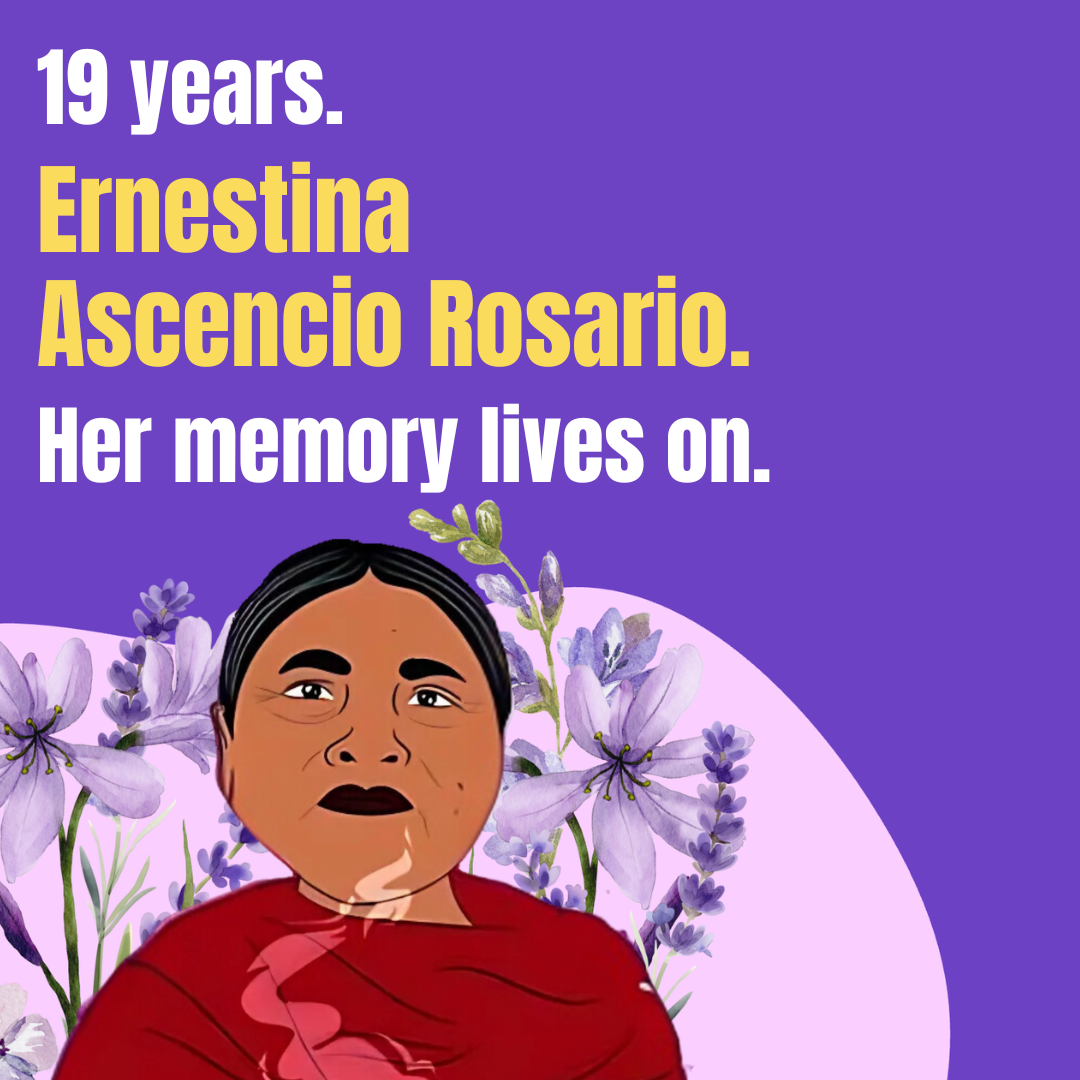
Nineteen years after these events, we remember Ernestina Ascencio Rosario with respect and dignity. Her memory lives on, and her case has set a fundamental precedent in the fight against impunity and discrimination. The truth has been recognized. Now, the ruling must be enforced.
Signed:
– Lawyers for Justice and Human Rights (AJDH)
– Heriberto Jara Municipal Services Center A.C. (CESEM)
– Kalli Luz Marina A.C.
– National Coordinator of Indigenous Women (CONAMI)
– Robert and Ethel Kennedy Human Rights Center
– International Institute on Race, Equality, and Human Rights