Inter-American Court of Human Rights Condemns the State of Mexico for Sexual Violence by Members of the Mexican Army, Torture, and the Death of Ernestina Ascencio Rosario
The family of Ernestina Ascencio Rosario and their representatives welcome the decision of the Inter-American Court of Human Rights (IACtHR), which, after nearly nineteen years of impunity and denial of […]
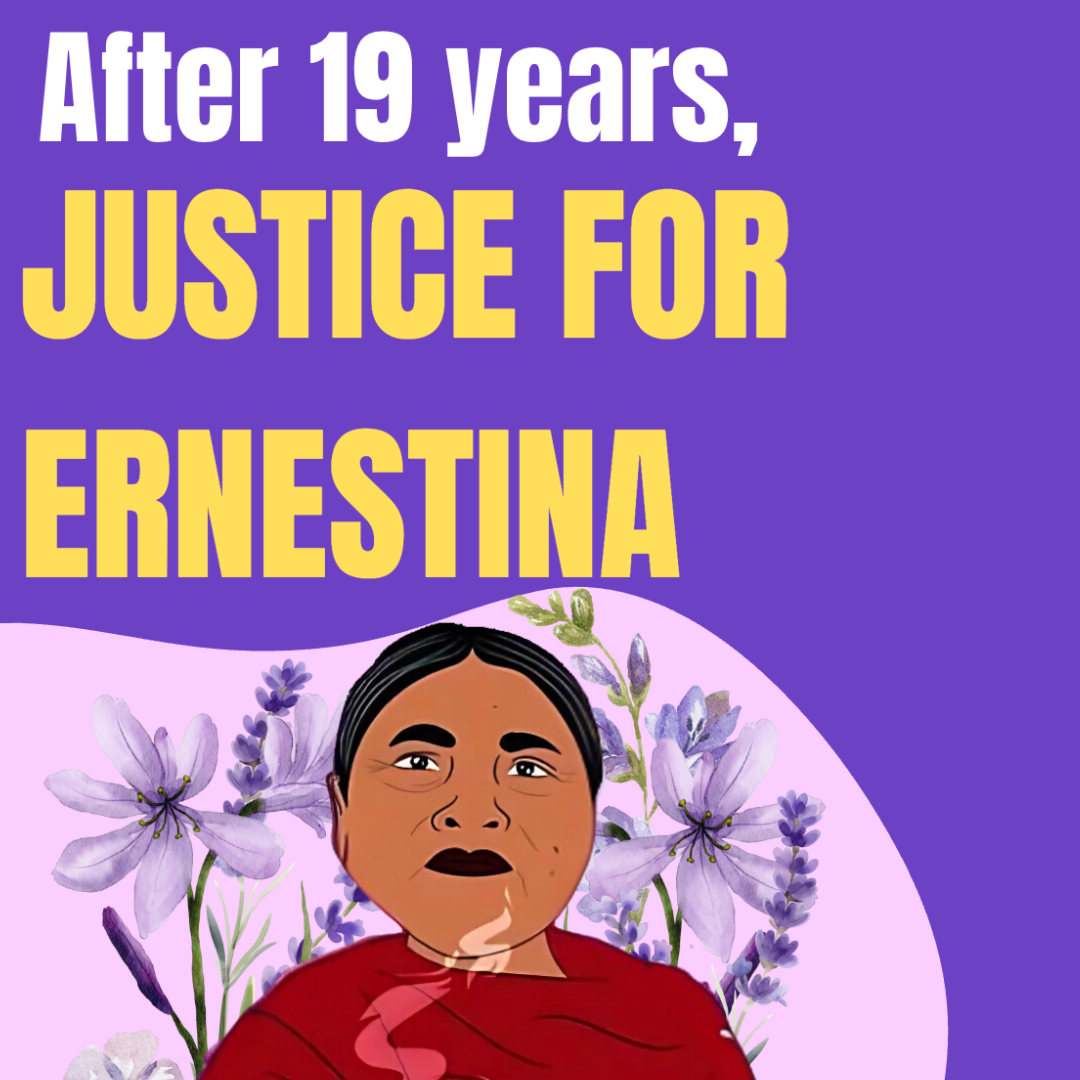
The family of Ernestina Ascencio Rosario and their representatives welcome the decision of the Inter-American Court of Human Rights (IACtHR), which, after nearly nineteen years of impunity and denial of justice by the State of Mexico, declared the State internationally responsible for the sexual violence, torture, and death of Ernestina Ascencio Rosario. Ernestina was a 73-year-old monolingual Nahua Indigenous woman who was assaulted in February 2007 by members of the Mexican Army in the Sierra de Zongolica, Veracruz.
The IACtHR’s decision is of historic significance, as it marks an important step in addressing the multiple barriers Indigenous women face in accessing justice in contexts of violence and discrimination based on ethnicity, gender, and economic exclusion. The Court held that the violations committed by the State against the victims resulted from institutional violence, structural discrimination, and the violation of the right to the truth, all of which led to impunity for those responsible. The judgment also advances the protection of older persons by recognizing that such protection is reinforced when age intersects with other factors of vulnerability, such as gender and ethnic origin, particularly in militarized contexts, where conditions of violence, exclusion, and structural discrimination are exacerbated.
In addition, the IACtHR reaffirmed the existence of structural obstacles faced by Indigenous peoples and individuals in accessing justice as a result of historical patterns of discrimination, marginalization, and social exclusion, and ordered the State to adopt measures to eliminate those barriers.
Through its systematic analysis of the factors that ensured impunity for those responsible, including public statements by high-level authorities, such as the President of Mexico, the Court made clear how State conduct perpetuated discrimination and impunity and deepened the vulnerability experienced by Ernestina and her family. Accordingly, the Court found that the State engaged in institutional violence against Ernestina Ascencio Rosario and her relatives. This approach to examining State action provides prosecutors and judicial authorities with a methodology to ensure compliance with due process guarantees and to protect victims’ rights, taking into account the specific conditions of vulnerability they face due to ethnicity, gender, and other discriminatory factors.
As a result, the Court ordered the State, among other measures of reparation, to carry out a thorough and serious criminal investigation, within a reasonable timeframe, into the sexual violence, torture, and death of Ernestina, leading to the punishment of those responsible; to adopt measures of satisfaction and rehabilitation, including providing culturally appropriate medical and psychological care to her family members; to make the judgment public and carry out a public act of acknowledgment of international responsibility; and to grant scholarships for basic, technical, and/or university education to Ernestina’s grandchildren who wish to pursue them. The Court also ordered the Mexican State to implement a training and capacity-building program for public officials on the matters addressed in the judgment; to strengthen the health center located in the Municipality of Soledad Atzompa; to adopt measures regarding health and justice with a gender-, ethnic-, and age-sensitive perspective; to address the linguistic barriers faced by Indigenous women in the State of Veracruz; and to develop a national registry of Indigenous-language interpreters. The State must report within one year on its compliance with these measures, and the Court will monitor their implementation until full compliance is achieved.
After learning of the judgment, Martha Inés Ascencio, daughter of Ernestina, stated: “I am very happy because on our own we did not know what we were going to do, and you supported us. Now, with this judgment, we know that they did listen to us. Three months before the 19th anniversary of my mother’s death, today I heard a bit of justice for what we have been fighting for, but the State still needs to comply with what it has been ordered to do.”
According to Patricia Benítez Pérez, coordinator of CESEM, “The IACtHR’s judgment honors the memory of Mrs. Ernestina Ascencio Rosario. The truth that was silenced for 19 years for the Inés Ascencio family has been vindicated before the highest court in the region, which upholds the truth and the words that Ernestina expressed during her lifetime:´Pinomeh xoxomeh nopan omotlatlamotlakeh´ (‘the men in green threw themselves on top of me.’)”.
For Julia Marcela Suárez Cabrera, representative of AJDH, “the claim we pursued to uncover the truth about the abuses committed against Mrs. Ernestina and her family made it possible for the IACtHR to provide them with justice and to order the State to implement measures of reparation for the victims and guarantees of non-repetition that ensure the rights of Indigenous women in Mexico.”
The representatives of the victims consider that the jurisprudence issued by the Court in this case will be a fundamental tool in the fight against the structural racism that, like in this case, is manifested in the racial discrimination faced by Indigenous women and other historically discriminated groups seeking judicial protection against the violence perpetrated against them.
The judgment comes nearly two decades after the events, following an uninterrupted search for truth, justice, and reparation that yielded no results, and led the Inter-American Commission on Human Rights to submit the case to the IACtHR in 2023. The prolonged lack of adequate State responses consolidated, up to the present day, a scenario of impunity and violation of the right to the truth that the Court’s decision seeks to correct, and which reflects the State’s structural failures to fully guarantee the human rights of Indigenous women, particularly the right to a life free from violence and discrimination, the right to a dignified life, and the right to adequate guarantees of access to truth and justice.
The organizations Abogadas y Abogados para la Justicia y los Derechos Humanos (AJDH), Centro de Servicios Municipales Heriberto Jara A.C. (CESEM), Kalli Luz Marina A.C., the Coordinadora Nacional de Mujeres Indígenas (CONAMI), the Robert and Ethel Kennedy Human Rights Center, and the International Institute on Race, Equality and Human Rights, as representatives of the victims, upon being notified of the judgment, formally requested that the Mexican State propose a roadmap for the full implementation of the ruling. This provides the State with an opportunity to honor its commitment in declaring 2025 the “Year of Indigenous Women” by fully complying with the judgment without further delay.
Press Contacts:
Abogadas y Abogados para la Justicia y los Derechos Humanos (AJDH)
Press Contact: Carmen Herrera, justiciayderechoshumanos2006@gmail.com, Whatsapp: +52 55 4347 6669
Centro de Servicios Municipales Heriberto Jara A.C. (CESEM)
Press Contact: Alejandra Arlet García López, centrohj@gmail.com, Whatsapp: +52 228 177 3127
Kalli Luz Marina A.C.
Press Contact: Elizabeth Guevara Mitzi, kallilegal23@gmail.com
Coordinadora Nacional de Mujeres Indígenas (CONAMI)
Press Contact: Patricia Torres Sandoval and Norma Don Juan Pérez, mujeresindigenasconami@gmail.com WhatsApp: +52 55 2407 8827
Robert and Ethel Kennedy Human Rights Center
Press Contact: Angelita Baeyens, baeyens@rfkhumanrights.org
International Institute on Race, Equality and Human Rights
Press Contact: Christina M. Fetterhoff, fetterhoff@raceandequality.org