The Struggle for Racial Equality in Light of International Mechanisms: Race and Equality and Its Commitment to People of African Descent, Indigenous Peoples, and the Roma
Washington, D.C., March 20, 2026.—On the occasion of the International Day for the Elimination of Racial Discrimination, the Institute on Race, Equality, and Human Rights (Race and Equality) reaffirms its […]
Washington, D.C., March 20, 2026.—On the occasion of the International Day for the Elimination of Racial Discrimination, the Institute on Race, Equality, and Human Rights (Race and Equality) reaffirms its commitment to combating structural racism and building more just, inclusive, and equitable societies in the Americas.
At Race and Equality, we work in close collaboration with individuals, communities, and peoples of African descent, Indigenous peoples, and the Roma, who continue to face historical and contemporary forms of discrimination that not only limit their ability to exercise their rights but also directly impact their living conditions, their access to opportunities, and their participation in society.
Far from being mere declarations, international human rights instruments establish specific obligations for states: to ensure substantive equality, eliminate discriminatory practices, recognize identities and cultures, and adopt specific measures to close historical gaps. In practice, however, these guarantees have not yet fully translated into structural changes.
At the international level, progress in recognizing the rights of Indigenous peoples and people of African descent has been essential to bringing these inequalities to light. Instruments such as the United Nations Declaration on the Rights of Indigenous Peoples not only recognize collective rights but also require states to respect self-determination, protect territories, and ensure effective participation in decisions that affect their lives.
Similarly, the process leading to a future United Nations Declaration on the rights of individuals, communities, and peoples of African descent represents a historic opportunity to establish standards that compel States to address the structural racism inherited from colonialism and slavery. This entails, for example, adopting public policies that guarantee equitable access to education, health care, employment, and justice, as well as recognizing and redressing the historical impacts of racial discrimination.
Nevertheless, Roma communities continue to face significant gaps in recognition within the international system, which results in their persistent invisibility in the Americas. This lack of recognition limits the adoption of specific public policies and perpetuates barriers to accessing basic rights.
Within the inter-American system, instruments such as the Inter-American Convention against Racism, Racial Discrimination, and Related Forms of Intolerance (CIRDI) reinforce these obligations by establishing that States must not only prohibit discrimination but also prevent, punish, and eradicate it through concrete actions. This includes collecting disaggregated data, recognizing affected communities, and designing public policies with their participation.
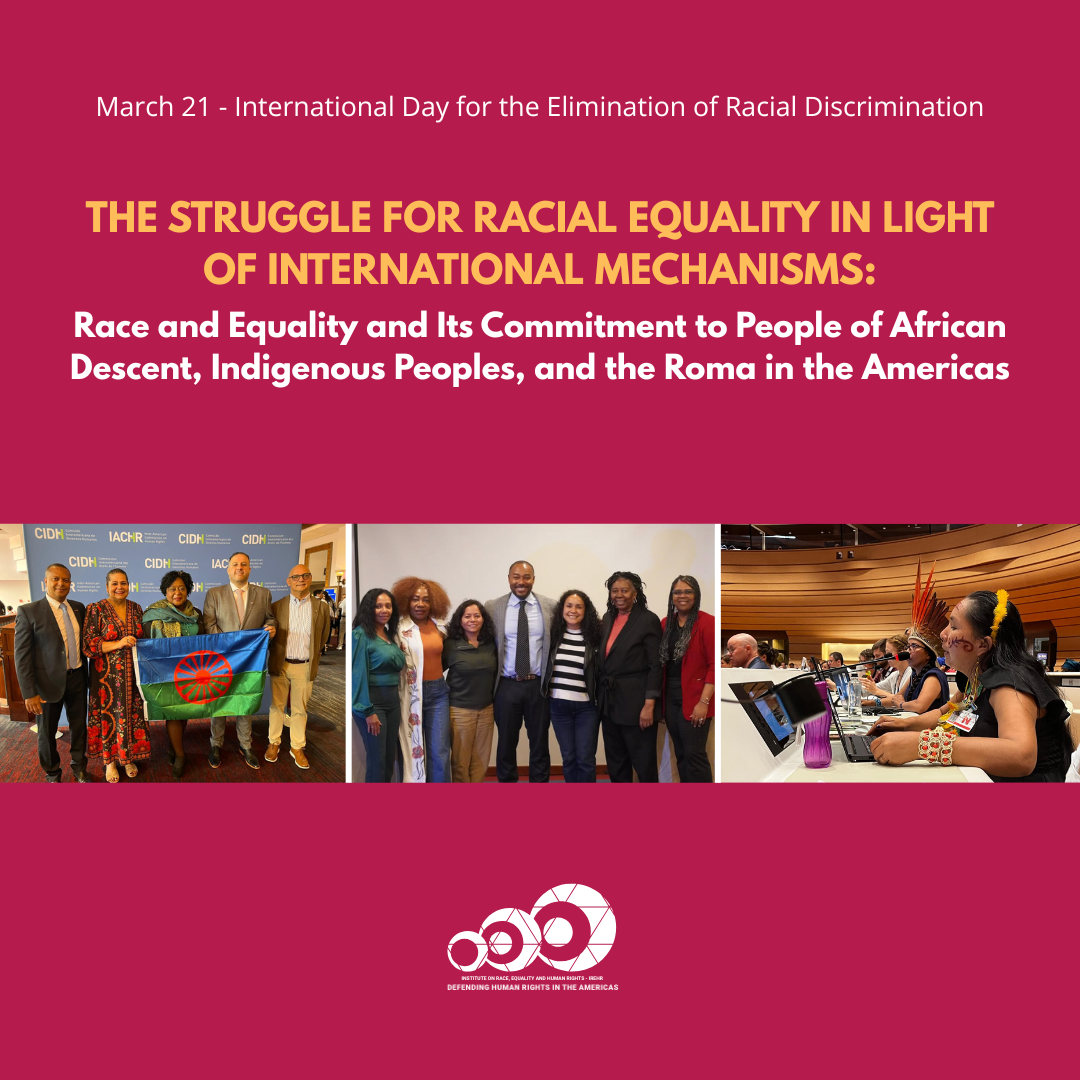
A recent example of these structural injustices was evident at the historic first hearing on the Roma people before the Inter-American Commission on Human Rights, held on March 9, 2026, and supported by Race and Equality. In this forum, Roma activists denounced how invisibility, structural racism, and the lack of state recognition continue to result in exclusion from the education system, barriers to accessing health services, and obstacles to accessing justice.
Such forums not only bring these issues to light but also reaffirm that states must move from formal recognition to effective action.
In the face of these challenges, at Race and Equality we reaffirm our commitment to:
- Strengthening the effective participation of individuals, communities, and peoples of African descent, Indigenous peoples, and Roma in decision-making, both at the national level and in international forums.
- Promote processes of memory, truth, justice, and reparations in the face of the legacies of colonialism, slavery, and structural racism.
- Highlight and document persistent inequalities, supporting organizations and activists in the defense of their rights.
- Incorporate an intersectional approach into all our actions, recognizing the multiple forms of discrimination faced by these populations.
- Promote the ratification of the Inter-American Convention against Racism, Racial Discrimination, and Related Forms of Intolerance (CIRDI), recognizing that this instrument provides concrete tools for States to adopt regulatory frameworks in this regard.
On this March 21, we call on governments, international organizations, and civil society to redouble their efforts to eradicate racism in all its forms. Equality cannot remain a mere promise: it must be translated into policies, resources, and concrete actions that guarantee dignity and justice for all people.