Recent Reforms Intensify Political Persecution in Nicaragua and Exile, Warns the OHCHR
Geneva, December 9, 2024 – “A severe and repressive climate prevails in Nicaragua,” stated Nada Al-Nashif, the UN Deputy High Commissioner for Human Rights, during her oral update on the […]
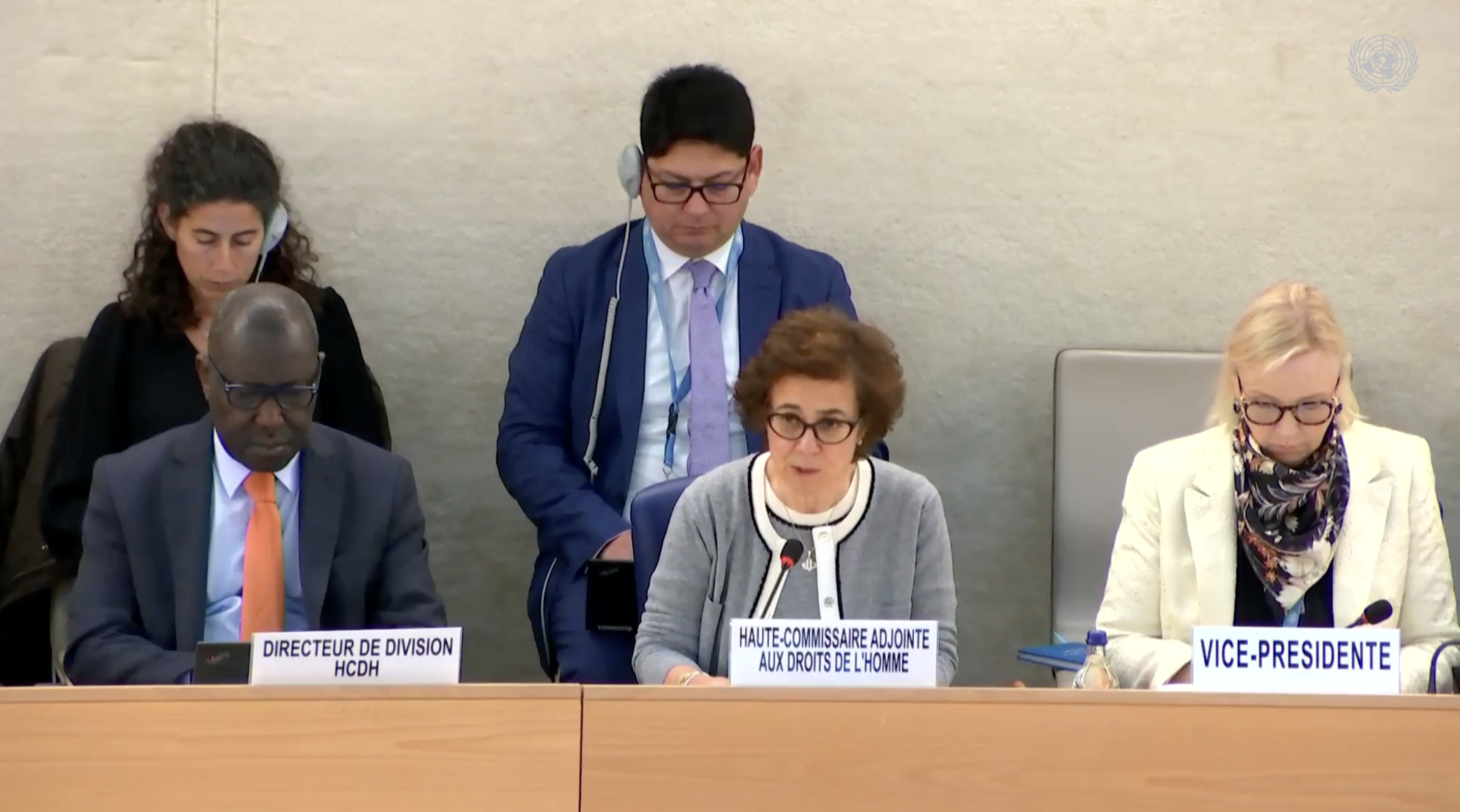
Geneva, December 9, 2024 – “A severe and repressive climate prevails in Nicaragua,” stated Nada Al-Nashif, the UN Deputy High Commissioner for Human Rights, during her oral update on the human rights situation before the United Nations Human Rights Council on Monday, December 9. In her statement, Al-Nashif warned that recent legal and constitutional reforms are consolidating power in the presidency and “paving the way for greater political persecution,” including against Nicaraguans in exile.
The Deputy High Commissioner noted that the recent legal reforms redefine crimes to include social media posts that “incite panic” or threaten “social stability.” They also classify cybercrimes as organized, authorize asset confiscation, and allow unrestricted access to personal data without police oversight.
The constitutional reforms approved by the National Assembly last month will increase executive interference in the legislative, judicial, and electoral branches. Al-Nashif described as “particularly atrocious” the removal of the explicit recognition of the prohibition of torture.
These changes aim to expand and strengthen government powers to strip people of their citizenship and confiscate assets, a tool already widely used to arbitrarily repress government critics and dissidents. Since February 2023, at least 546 people have been deprived of their nationality, had their assets confiscated, and been exposed to statelessness. Many of these individuals cannot renew their documentation, hindering their connection to their country. In addition, the Supreme Court stripped 135 former political prisoners of their nationality and assets, and exiled them to Guatemala in September.
Constant Pattern of Arbitrary Detentions, Torture, and Forced Disappearances
The Office of the UN High Commissioner for Human Rights (OHCHR) has documented a consistent pattern of arbitrary detentions, torture, and forced disappearances. Currently, 76 people remain in detention for political reasons, including 20 indigenous people, and 30 individuals were arbitrarily detained in late November. Regarding forced disappearances, OHCHR highlighted the forced disappearance of Angélica Chavarría, a companion of the late retired General Humberto Ortega, since May 2024; the disappearance of Brooklyn Rivera, a member of the National Assembly from the indigenous YATAMA party, since September 2023; the disappearance of Steadman Fagoth Müller, presidential advisor on indigenous affairs, since September 2024; and the former colonel Victor Boitano (63 years old), who has been missing since April 2024.
“Forced disappearance, torture, and ill-treatment must cease unequivocally,” urged the Deputy High Commissioner.
Indigenous Peoples Exposed to Violence
The Deputy High Commissioner expressed deep concern over the ongoing attacks on indigenous peoples in the Autonomous Region of the North Caribbean Coast of Nicaragua, fueled by violence from settlers or non-indigenous third parties. The murder of two Miskitos on November 8, and reports of sexual violence against indigenous children allegedly committed by settlers, reflect the severe insecurity they face.
The Deputy High Commissioner called for the immediate release of eight Mayangna rangers who have been detained in extreme conditions since 2021, “Authorities must take proactive measures to prevent violence, including sexual violence, and conduct thorough and independent investigations into all these incidents, holding perpetrators accountable.”
Finally, the Deputy High Commissioner called on “the international community, including all States committed to the region and those with influence, to intensify their efforts to support these objectives.” The Office also reiterated its commitment to providing technical assistance to Nicaragua.
Council Members Concerned about Nicaragua’s “Co-Presidency”
In the interactive dialogue with the Deputy High Commissioner, Council members and civil society organizations called for the immediate release of political prisoners, annulment of their judicial processes, restoration of citizens’ rights, and the lifting of restrictions on NGOs, media, and religious groups. Several delegations, including Peru, Canada, Costa Rica, Paraguay, the United Kingdom, Switzerland, among others, expressed deep concern over the recent legal and constitutional reforms, particularly the establishment of a “co-presidency” that centralizes power in one family.
“It is concerning to see the explicit elimination of powers, now simply referred to as organs, and the ability of the new co-presidents to coordinate with absolute and unlimited power… This new attack on Nicaraguan institutions must inevitably be interpreted as a near-final blow to democracy,” stated the Costa Rican delegation.
The United Kingdom described the recent constitutional reforms as “an additional tragic chapter in the deterioration of political civil rights and other human rights of Nicaraguans,” and called on Nicaraguan authorities to accept the recommendations made in the Universal Periodic Review (UPR).
Canada urged the renewal of the High Commissioner’s and the Group of Experts’ mandates in March 2025. The European Union called on Nicaragua to expand its cooperation with both mandates and other human rights mechanisms “to fulfill its reporting obligations under the treaties it has ratified.”
From civil society organizations’ microphones, Tininiska Rivera, daughter of indigenous deputy Brooklyn Rivera, and Ingni Fagoth, daughter of Miskito leader Steadman Fagoth, denounced the forced disappearances of their fathers.
Tininiska also denounced the cancellation of the legal personality of the YATAMA party and the Moravian Church, as well as the illegal occupation of indigenous territories by armed settlers. She also pointed to the rise in violence against indigenous communities in 2024, including the murder of four rangers, the criminalization of 37, and the disappearance of indigenous leaders.
Ingni warned that her father’s detention by the Nicaraguan Army is part of a systematic and widespread attack against indigenous peoples for political reasons. “We demand justice… Our people are standing, but we need the support of the international community. Do not abandon Nicaragua’s indigenous people,” she urged.
Other organizations highlighted the arbitrary closure of more than 5,000 NGOs, 12 repressive laws passed in the past four months, 222 documented cases of torture, 452 cases of people arbitrarily stripped of their nationality, and the unemployment of at least 1,200 teachers and university staff, among others.
Statement
The oral update by the Deputy High Commissioner and the subsequent interventions by States and civil society organizations make it clear that the human rights crisis in Nicaragua has reached one of its most critical points. In this grave context, the Institute on Race, Equality and Human Rights (Race and Equality) supports the call by the Deputy High Commissioner to the international community to intensify efforts in support of the Nicaraguan population, with special attention to those in exile, indigenous and Afro-descendant peoples, and those who remain deprived of liberty for political reasons.
Impunity cannot prevail in the face of the systematic and severe human rights violations occurring in the country. We call on the United Nations and States committed to democracy and human rights to strengthen monitoring and protection mechanisms and to vote in favor of renewing the mandate of the Group of Experts on Human Rights in Nicaragua (GHREN) in 2025. This mandate is essential for deepening the documentation of human rights violations, ensuring accountability, and strengthening international pressure in defense of the Nicaraguan population.