Institute Holds the Colombian State Responsible for the Assassination of Bernardo Cuero, leader from the National Association of Displaced Afro-Colombians: Another Leader the National Protection Unit Has Failed to Protect
The International Institute on Race, Equality and Human Rights profoundly laments, denounces and repudiates the assassination on June 7 of Bernardo Cuero, Afro-Colombian leader and member of the governing board […]
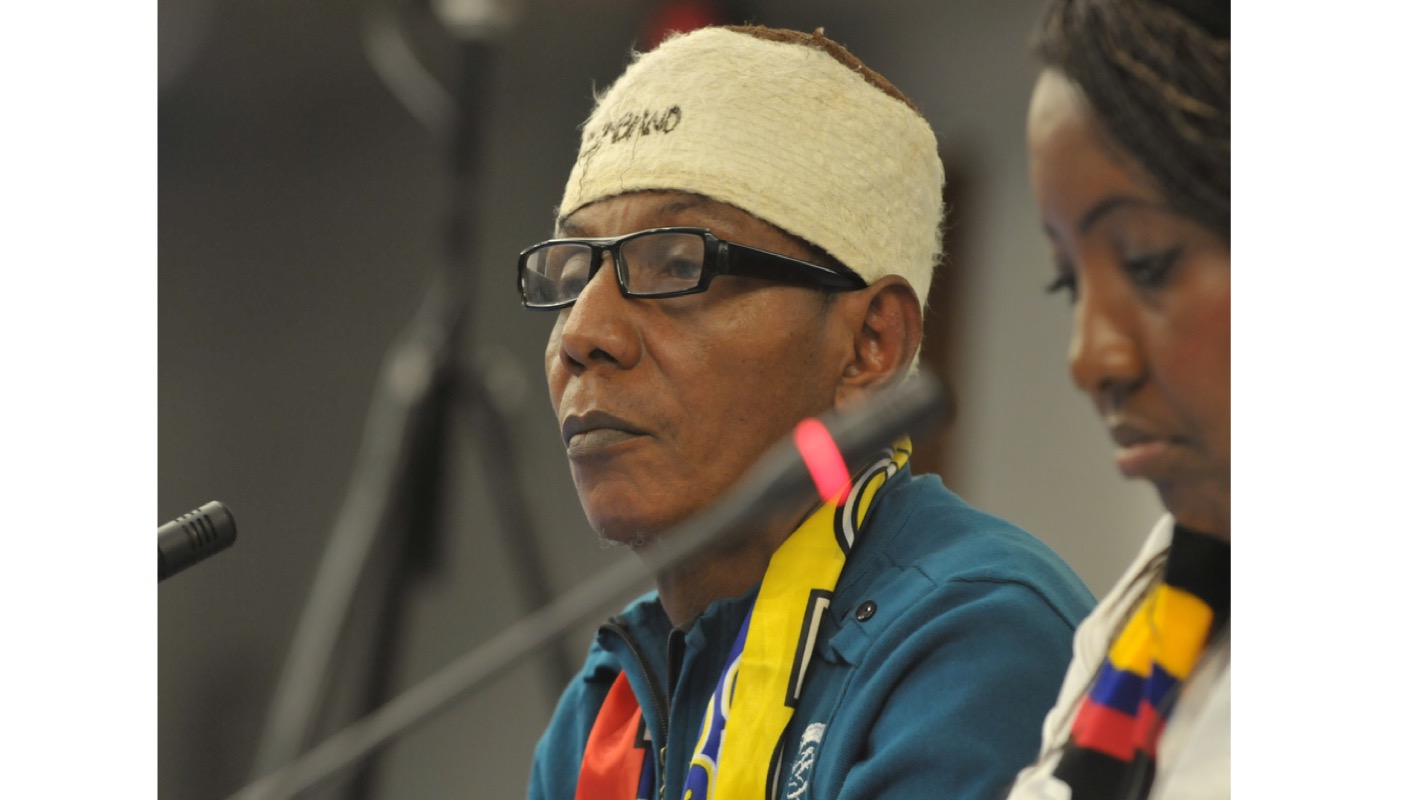
The International Institute on Race, Equality and Human Rights profoundly laments, denounces and repudiates the assassination on June 7 of Bernardo Cuero, Afro-Colombian leader and member of the governing board of the National Association of Displaced Afro-Colombians (AFRODES).
Bernardo’s critical security situation, itself a result of his and his family’s displacement due to violence associated with the armed conflict, had been documented and denounced at the national and international levels. In October 2013, he appeared in a public hearing before the Inter-American Commission on Human Rights (IACHR) to report on his own security situation and those of other AFRODES members. At the hearing, Bernardo spoke of his own case, saying, “despite the denouncement of each occurrence, there are no investigations or findings for any of them.” He also spoke of his role as an Afro-Colombian human rights defender and its relation to the security threats he received, adding: “To demand respect for our right to conduct our advocacy work on behalf of our communities cannot be a reason to condemn us and our families to death.” In fact, after the hearing, threats and attacks increased against him, as well as against Erlendy Cuero Bravo, Vice-President of AFRODES. More recently, in March, in a public hearing before the Commission requested by the Colombian state to discuss the topic of threats against social leaders, the Institute again denounced the critical security situation of AFRODES leaders, including Bernardo, for whom the state had continued to deny protection measures. The failure to provide this necessary protection places the responsibility for Bernardo’s death on the state of Colombia.
In this heinous attack, the assailants tracked Bernardo to his home in Malambo, in the Department of Atlántico. All the details of the attack have yet to be made public, but one thing remains clear: the Colombian state systematically denied Bernardo adequate protection measures, despite the numerous requests made after several threats and attempts on his life. As in the cases of other social leaders, the results of the risk assessment found—absurdly—that the level of risk he faced was “ordinary.” The “risk assessment” process has been a failure and it has failed one more leader. Bernardo had said—as other leaders facing similar situations had said as well—that the only way the Colombian state would recognize that an extraordinary risk existed would be if “they killed you.”
With this most recent assassination of an AFRODES member, the Institute demands that the Colombian state undertake an immediate investigation of the crime and provide reparations and protection for Bernardo’s family. Moreover, the state must immediately provide protective measures to all AFRODES members and accept responsibility for its failure to act in Bernardo’s case and those of his colleagues.
The Institute also calls on international human rights institutions and members of the international community who support peacebuilding efforts in Colombia to forcefully urge the Colombian state to investigate the crime against Bernardo and to immediately grant the necessary individual and collective protective measures to AFRODES and other organizations representing Colombia’s ethnic communities.
Lastly, we urgently request that the Colombian state comply with Precautionary Measure 658-16 granted to Erlendy Cuero Bravo, Vice-President of AFRODES. At the same time, we urge the Inter-American Commission on Human Rights, the UN Special Procedures and the Committee for the Elimination of Racial Discrimination to continue to monitor and act in favor of the protection of human rights defenders in Colombia, given that the state of Colombia and its institutions, through indifference and failure to act in the face of attacks and assassinations of Afro-Colombians, have been unable to protect those who defend their people’s territory, world view, and human rights.