Brooklyn Rivera: the Father, the Leader, and the Search of a United Caribbean Coast
Washington, D.C., September 29, 2025. – To the world, Brooklyn Rivera was a Miskitu Indigenous leader, an advocate for the rights of the peoples of the Caribbean Coast, and a […]
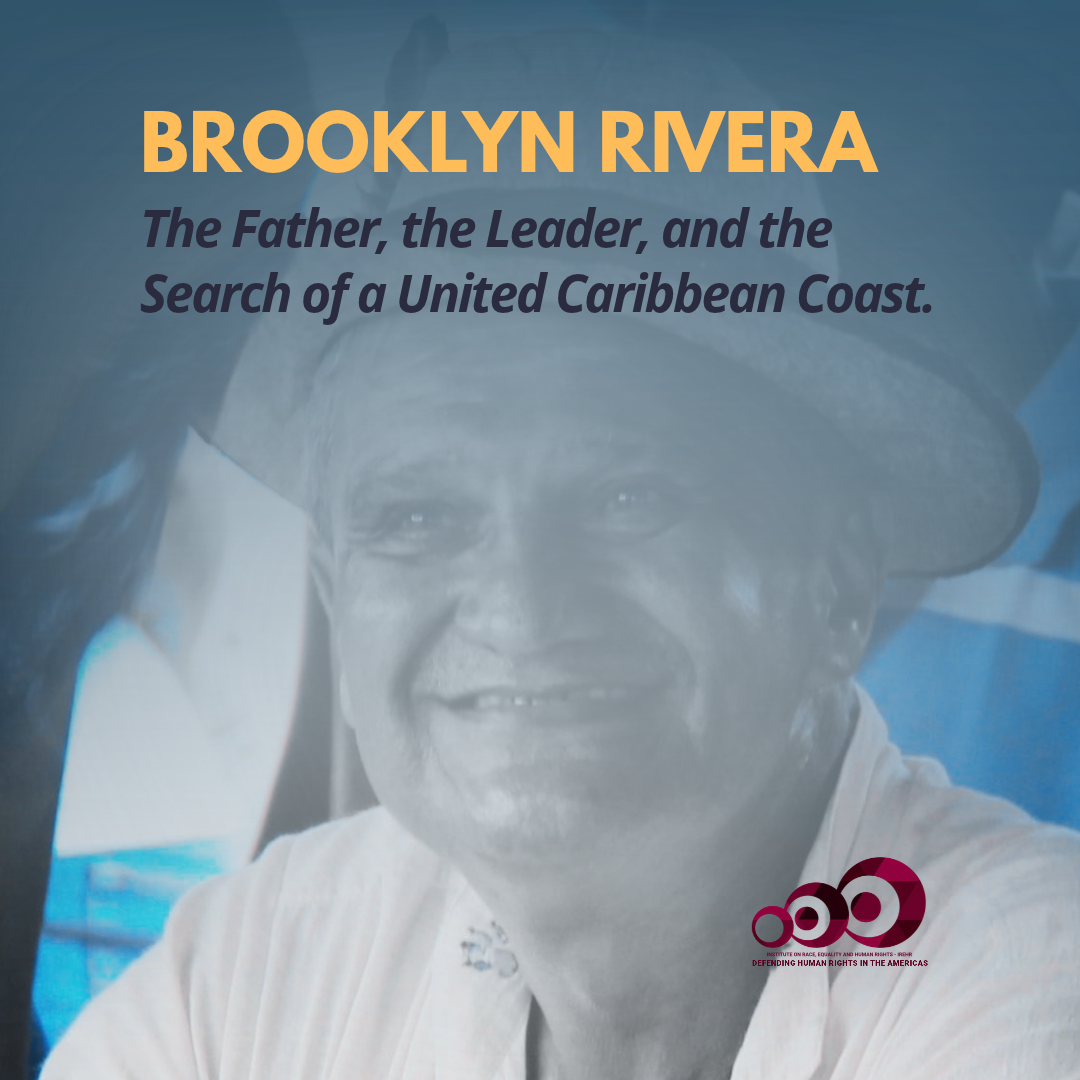
Washington, D.C., September 29, 2025. – To the world, Brooklyn Rivera was a Miskitu Indigenous leader, an advocate for the rights of the peoples of the Caribbean Coast, and a central figure in the Indigenous organization Yatama. To his daughter Tininiska, he was also the father who celebrated each of her birthdays, sang Miskitu and religious songs to her, and supported her through every stage of her education.
That more personal aspect was one of the themes that emerged during the virtual event held in his memory, titled “The Voice They Could Not Silence: Brooklyn Rivera and the Struggle for Indigenous Peoples’ Autonomy in Nicaragua,” organized by Race and Equality, and featuring his daughter Tininiska Rivera, anthropologist and political scientist Miguel González, and Mayangna indigenous advocate Rendel Hebbert, with Carlos Quesada, Executive Director of Race and Equality, serving as moderator.
Rather than retracing his political career, the gathering offered a chance to look at Ta Upla Brooklyn Rivera through the voices and experiences that help us understand who Brooklyn Rivera truly was and what ideas guided his life.
A father who saw education as a form of defense
Tininiska recalled that her father chose her name, which means “sparrow,” but when they were alone, he called her “Kabuyula”—the name given to a bird smaller than a sparrow that is found mainly on the Caribbean coast. She also recalled that he was present at her birthdays from the time she was born until she turned 29. There were gifts, lunches, cakes, and time spent together.
She also recalled a lesser-known aspect of his life: his spirituality. Brooklyn would sing songs to her in Miskitu and religious songs; he read the Bible frequently and attended church regularly. Faith, Tininiska said, was part of his daily life. But if there is one thing that deeply shaped their relationship, it was the importance Brooklyn placed on education.
From a young age, he urged her to study, to prepare herself professionally, and to acquire the necessary tools to defend the rights of indigenous peoples. Tininiska said that, for him, education was not just a path to personal fulfillment—it was also a tool that would enable indigenous people to represent their communities and defend their rights.
Tininiska shared that her father supported her throughout elementary school, high school, and college, and that he celebrated each of those achievements with special pride; after she earned her college degree, he told her, “That is the greatest legacy I can leave you for life.”
She also mentioned that although he always celebrated her birthdays, he wasn’t one to celebrate himself on his own birthday, which fell on September 24 every year. However, there was never a shortage of tributes from his family, friends, and community. She, in particular, was the one who prepared food and a quequisque or cassava cake to bring to them.
A Leadership Marked by the Pursuit of Peace and Autonomy
Brooklyn Rivera’s public history was closely linked to the organization and political advocacy of the peoples of the Caribbean Coast.
Miguel González, an associate professor at York University in Canada and a native of Bluefields, traced his first steps in leadership to the 1970s, when, as a college student, Brooklyn began to connect with other young people, teachers, and community leaders concerned about the historical discrimination the peoples of the Caribbean Coast faced.
The creation of MISURASATA was one of the pivotal moments in that process, according to González, who noted that years later, in 1987, the founding of Yatama marked another decisive moment: the search for a political organization capable of bringing together different voices from the Caribbean Coast and participating in the peace process and the region’s political life.
For González, one element runs through this entire journey: the pursuit of peace and autonomy. In his words, Brooklyn understood that on the Caribbean Coast it was necessary to engage in dialogue, negotiate, and reach lasting agreements, and that commitment did not fade with the passage of time or political changes but remained a way of understanding politics and leadership.
Nor was his vision limited to a single people. González emphasized that Brooklyn upheld the idea of a united Caribbean Coast—comprising indigenous peoples, Afro-descendant communities, and the mestizo coastal population—as part of a project aimed at autonomy and the recognition of rights.
“Unity in Diversity”
That perspective also emerged in the testimony of Rendel Hebbert, who had known of Brooklyn since childhood, when he first heard his name from relatives involved in the defense of indigenous peoples’ rights and autonomy.
For Hebbert, Brooklyn did not build his leadership solely around the Miskitu people; rather, an important part of his legacy lay in his efforts to forge relationships among the various peoples of the Caribbean Coast. He summed this up in a phrase that recurred throughout his remarks: “unity in diversity.”
According to his testimony, this idea was expressed through concrete actions to secure representation for the Mayangna people and other communities within Yatama and in various forums for political and regional participation.
Likewise, in the role Brooklyn Rivera played in the founding of the University of the Autonomous Regions of the Nicaraguan Caribbean Coast (URACCAN) and the Bluefields Indian and Caribbean University (BICU), or in the passage of Law 445, which regulates the communal land tenure system for the indigenous peoples and ethnic communities of the Caribbean Coast and the Coco, Bocay, Indio, and Maíz river basins.
A concern that dates back to before 2018
The defense of the territory also features in Tininiska’s memories. She recounted that her father had been expressing concern about the situation of Indigenous peoples for years. Since 2014, she said, he had been watching with unease what was happening in Nicaragua and, in particular, the conditions in the autonomous regions, which have historically been isolated from the country’s centers of power.
With the 2018 crisis, that concern deepened even further. Tininiska recalled that Brooklyn believed the situation could worsen and warned of the risks to Indigenous peoples and their territories, especially given the presence of companies and projects that, in his view, could affect Indigenous territories and their resources.
Beyond the Name
Brooklyn Rivera is often associated with major political events in the recent history of Nicaragua’s Caribbean Coast. However, the voices gathered at this conversation offer a glimpse into a person who existed beyond that public dimension.
He was the father who chose his daughter’s name. The man of faith who sang in Miskitu and read the Bible. The father who made his daughter’s education one of his greatest legacies. The leader who, according to those who knew his career, upheld peace and autonomy as central tenets of his philosophy. And the leader who sought to build bridges between different peoples under the banner of unity in diversity.
Remembering him through these different dimensions helps us understand that his legacy is not limited to the positions he held or the organizations he helped build. It also lies in the ideas he passed on, the people he mentored, and his understanding of the defense of Indigenous peoples as a collective endeavor.
Brooklyn Rivera died on May 30, 2026, while in state custody, after more than 970 days of enforced disappearance. September 29 marks the third anniversary of his arbitrary detention and remembering his legacy is a way to honor his struggle and his memory. At Race and Equality, we remain committed to continuing to work alongside his family and human rights organizations to secure truth, justice, and reparations for his loved ones and for the Indigenous and Afro-descendant communities in Nicaragua.