Organizations File a Complaint with the IACHR Regarding the Expansion of Extractive Policies in Nicaragua and Their Impact on the Human Rights of Indigenous Peoples and People of African Descent
Washington, D.C., August 4, 2026. As part of the 196th Session of the Inter-American Commission on Human Rights (IACHR), a public hearing was held on August 3, during which human […]
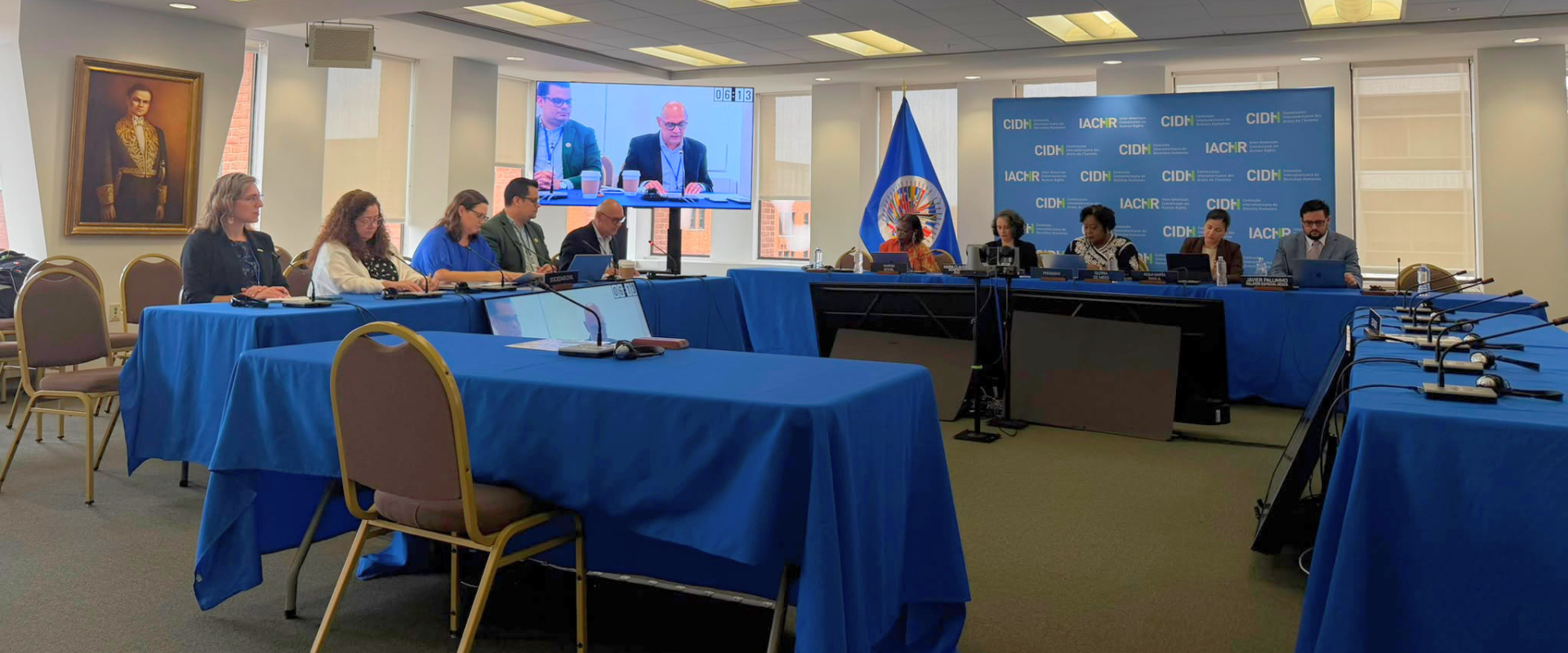
Washington, D.C., August 4, 2026. As part of the 196th Session of the Inter-American Commission on Human Rights (IACHR), a public hearing was held on August 3, during which human rights and environmental organizations presented the main impacts resulting from the expansion of the extractive model in Nicaragua.
Participants in the hearing included the Institute on Race, Equality, and Human Rights (Race and Equality), the Fundación del Río (FdR), and the Center for Justice and International Law (CEJIL), which presented findings and testimonies on the territorial, environmental, and social consequences of mining activity in Nicaragua.
The organizations emphasized that this situation stems from a historical failure on the part of the Nicaraguan government to complete the process of regularizing the territories titled under the Law on the Communal Property Regime of Indigenous Peoples and Ethnic Communities (Law 445), as well as the absence of a legal framework that recognizes and protects the territorial rights of indigenous peoples in the Pacific, Central, and Northern regions of the country.
They noted that the constitutional and legal reforms promoted in recent years by the Nicaraguan government have further eroded the autonomy of the Caribbean Coast and reduced the decision-making capacity of indigenous and Afro-descendant authorities over their own territories. For these organizations, the expansion of mining represents the continuation of an extractivist model that prioritizes the exploitation of natural resources over the collective and individual rights of the peoples.
Carlos Quesada, executive director of Race and Equality, stated that the lack of land titling has allowed non-indigenous settlers to encroach on indigenous lands, leaving the communities completely unprotected.
“Far from addressing this historical debt, the State has further eroded territorial guarantees. Recent constitutional and legal reforms have dismantled the Caribbean Coast’s autonomy regime, subordinating the Regional Councils and communal and territorial authorities to the central government and stripping indigenous and Afro-descendant peoples of their mechanisms for participation and decision-making regarding their own territories,” said Quesada.
He added that this process is taking place against a backdrop of the complete closure of civic space and repression, which translates into “the persecution and criminalization of their leaders. Furthermore, invasions by settlers subject these communities to systematic violence, including sexual violence and murders.”
For his part, Amaru Ruiz, president of Fundación del Río, reiterated that the state’s extractivist policy has progressively dismantled safeguards for the protection of indigenous and Afro-descendant territories, such as the elimination of environmental and territorial controls—including prior environmental impact assessments for mining projects and mandatory public consultation—and the modification of the institutional structure to concentrate control over mining.
Ruiz warned that the expansion of the extractive model has intensified the use of mercury and cyanide in mining operations, in addition to contributing to the persistence of child labor in mining areas. He also noted that, for the first time, legislation allows mining activities to take place within protected natural areas.
As a result of this model, Ruiz noted that currently 75 mining concessions affect 19 protected areas and two biosphere reserves, compromising more than 900,000 hectares. Among the impacted areas are the Bosawas Biosphere Reserve and the Indio Maíz Biological Reserve, two of the country’s main remaining forest areas.
Alejandra Manavella, of CEJIL, explained that the consequences of mining expansion are reflected in the transformation of these territories, as well as in the impact on the ecosystems on which these communities depend. She noted that there are currently 62 mining concessions affecting 18 indigenous and Afro-descendant territories, compromising 25.5% of communal lands. In addition, she noted that these concessions impact 163 rivers, 80 streams, and 1,900 km of waterways, and affect the Bosawas and Río San Juan.
Manavella warned that this extractivist model is linked to forced displacement, violence, and the criminalization of those who defend their territories. Between 2013 and 2024, at least 69 Indigenous people were murdered in this context. He also cited the cases of Brooklyn Rivera, Nancy Henríquez, Steadman Fagoth, and the eight Mayangna forest rangers as examples of persecution against Indigenous leaders.
This is compounded by the expansion of the agricultural frontier, invasions by settlers, and environmental migration, which particularly affect Indigenous and Afro-descendant women.
As part of the hearing, Lee Bell, a technical and policy advisor for the International Pollutants Elimination Network (IPEN), presented virtually the results of a pilot study on mercury concentrations in Nicaraguan indigenous women of childbearing age living in an area where small-scale mining takes place in the country’s northern Caribbean region. The video of the presentation, with Spanish subtitles, can be viewed here.
On behalf of the IACHR, Commissioner Rosa María Payá, Rapporteur for Nicaragua, recalled that the Commission has repeatedly documented that, in the context of the consolidation of the authoritarian regime, indigenous peoples and people of African descent face a pattern of territorial dispossession, violence, erosion of their autonomy, and persecution of their leaders—a situation exacerbated by the expansion of extractive activities that disregard the guarantees of free, prior, and informed consent.
Commissioner Marion Bethel, Rapporteur on Women’s Rights, called for a more in-depth examination of the effects of mercury use in mining and its impact on health, particularly that of women, girls, and boys. She also expressed concern about the consequences this activity has on the increase in gender-based violence in affected communities.
The Commissioner also inquired about the impact of the sanctions imposed by the United States and other countries on Nicaragua’s mining sector, and how these sanctions affect the well-being and rights of indigenous peoples and people of African descent, given that some of the mined minerals continue to reach international markets. Finally, she requested clarification on the use and extraction of water by mining companies, particularly regarding the authorizations and concessions granted by the National Water Authority for these activities.
For his part, Javier Palummo, Special Rapporteur on Economic, Social, Cultural, and Environmental Rights (Redesca), stated that the discussion is not limited to mining operations and environmental impacts, but rather encompasses an issue of territorial governance and the distribution of power.
“When concessions overlap with collective territories and protected areas, and when mechanisms for environmental assessment, transparency, and participation are weakened—especially in contexts where civic space is being restricted— these types of circumstances give rise to violence against human rights defenders, displacement, and violence against communities, and not only are collective property, self-determination, the right to a healthy environment, water, health, and food compromised, but so too are communities’ opportunities to develop with dignity,” said Palummo.
At the conclusion of the hearing, the organizations requested that the IACHR strengthen its monitoring of the situation in Nicaragua, specifically incorporating the impacts of mining expansion on indigenous and Afro-descendant territories; coordinate this monitoring with oversight of compliance with the Awas Tingni judgment before the Inter-American Court of Human Rights; and strengthen coordination with the mechanisms of the United Nations Universal System to reinforce international scrutiny of Nicaragua. They also asked the Commission to urge OAS member states involved in the mining industry—whether as sources of capital or destinations for minerals—to ensure that companies comply with their human rights obligations.