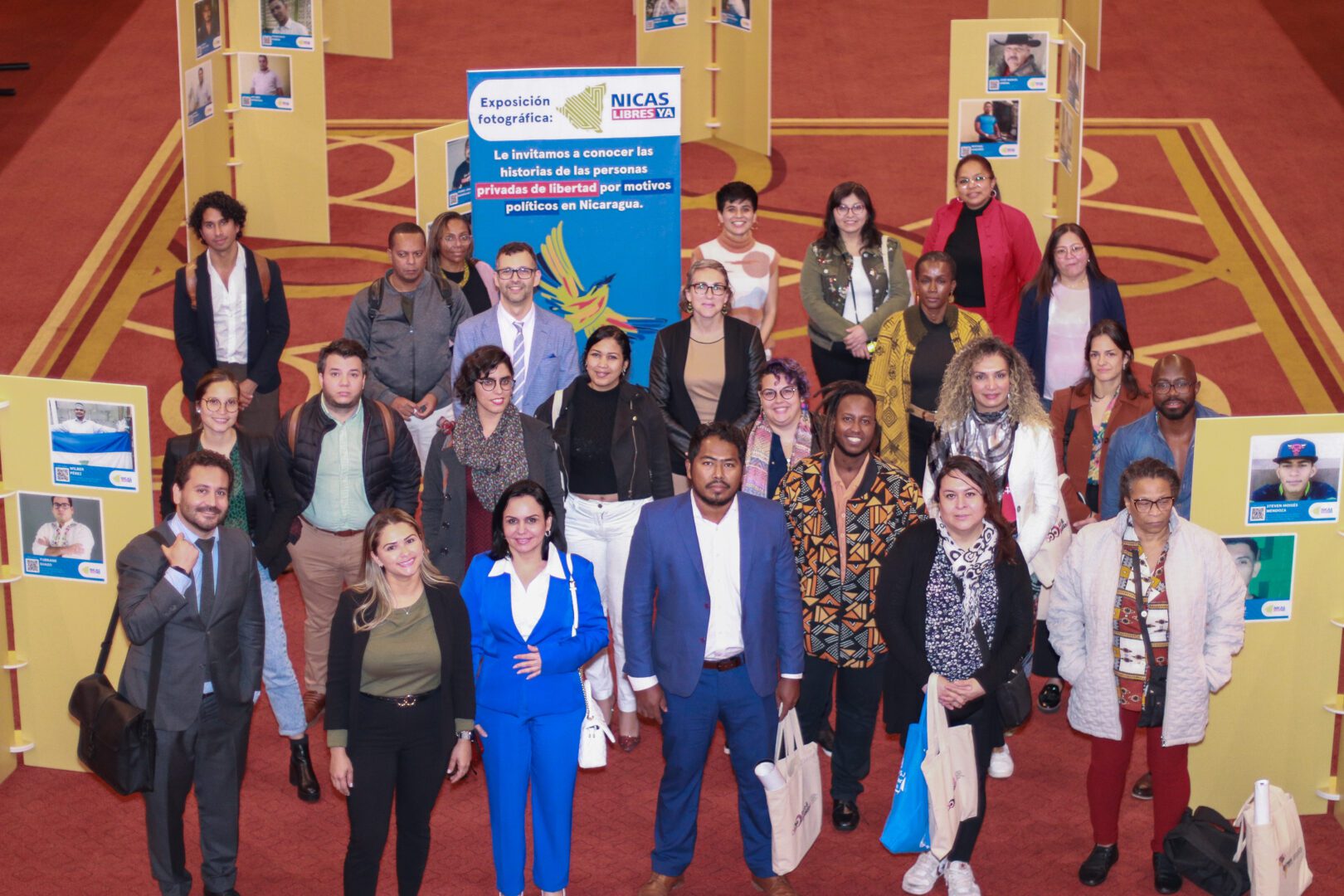
Race and Equality supports a Nicaraguan delegation to the United Nation in Geneva, Switzerland

Race and Equality supports a Nicaraguan delegation to the United Nation in Geneva, Switzerland

June 2018 – The Institute on Race, Equality and Human Rights (Race and Equality) supported a delegation of Nicaraguan human rights activists to the United Nations in Geneva, Switzerland  June 18-29 in order to raise awareness about the human rights situation  in Nicaragua before civil society representatives, governmental missions before the UN,  the UN System of Human Rights and the international community at large.   Among them,  Alexandra Salazar of the Network of Social Movements and Civil Society Organizations of Nicaragua, Oswaldo Montoya of the MenEngage Alliance, Ana Quirós of the Center for Health Information and Advisory Services (CISAS), and Anibal Toruño of Radio Darío.

Over the course of the two-week trip, the Nicaraguan activists met with important international actors, which included staff of the Office of the High Commissioner of Human Rights (OHCHR), members of international civil society, and representatives of the Permanent Missions of member countries – many from the Latin-American region – to present their stories and offer insight on the response needed to the current political crisis, including the repressions face and the increase of attacks against civil society representatives, students, the elderly, and other peaceful protestors. Their testimonies also sought to encourage the UN Human Rights Council (HRC) to issue out a communication requesting that the Nicaraguan government put a stop to the violence and repression.

The activists participated in two press conferences before national and international media, which was broadcasted live through our social platforms. During the debates, the activists denounced the repression and violations of fundamental human rights at the hands of “paramilitary”, “Sandinista mobs”, and “Parapolice” groups.

Groups can be seen here: — https://goo.gl/NdRgtN

In addition, the delegation participated in the plenary of the 38thperiod of the Human Rights Council (HRC), and in two parallel events. The first one, “Human Rights in Nicaragua: State violence and repression”, organized by the International Human Rights Network and the MenEngage Alliance, featured close to fifty participants, including Commissioner Joel Hernandez of the Inter-American Commission on Human Rights (IACHR). The event discussed the causes of the civil unrest and the presentation of a report by Nicaragua’s Permanent Commission on Human Rights’ (CPDH). The event concluded by urging the international community to denounce the situation in Nicaragua and to pressure the national government to put an end to the repression.

The event was broadcasted live through our social channels. You can see a replay here (in Spanish) — https://goo.gl/NdRgtN

The second event was organized by the Inter-American Commission on Human Rights, to present the report: Grave violations of human rights in the context of social protests in Nicaragua. It was also broadcasted in our social platforms and can be seen here: https://goo.gl/mmuPQZ

Finally, the Nicaraguan  activists urged the international community to continue pressuring the Nicaraguan government to accept a visit of the UN Office of the High Commissioner to the country (that was later accepted); to publicly denounce government actions against its own citizens; and to request that the UN and its member states form an Independent Investigation Commission to review and sanction all crimes committed. (at the time of drafting this release there were more than 200 registered deaths associated with the conflict.)

SO THAT OUR VOICES ARE HEARD AND INCLUDED! Today We Commemorate the International Day for Afro-Latino, Afro-Caribbean, and Diaspora Women

July 25 marks the International Day for Afro-Latino, Afro-Caribbean, and Diaspora Women. The commemorative date was established in 1992 after a meeting in the Dominican Republic of more than 400 women from diverse Latin American countries, where they analyzed the consequences of racism and sexism in the region. The meeting also provided a space for attendees to articulate joint actions and remember historic struggles to combat these issues.

On this day we remember that the fight to bring down the humiliations caused by discrimination, poverty, and violence is ongoing. Participatory spaces are closed off because of racist and discriminatory logic against women and Afro-descendants which prevail. Women from the region continue to be the victims of a hostile war committed to condemn their voices and their chants, to violate their bodies, and take away their children.

It is important to remember that Afro-descendant women’s organizations have undertaken a lot of efforts to achieve recognition and participation in decision-making spaces. Because of this, we urge all states to promote affirmative actions in favor of including Afro-Latino, Afro-Caribbean, and Diaspora voices in spaces that will permit the promotion of effective public policies that guarantee rights and severely condemn all types of ethnic or racial discrimination.

Today we rise up in resistance for the women suffering the war and apathy in Nicaragua, for the harassment and repression against women in Colombia, especially those who are persecuted for leading life in the territories. We rise up for those women who are not recognized and who are discriminated against in Peru; for the violence and harassment against trans women in Brazil; for the voices of the women in Panama; for the recognition of the rights of all women in the region. We will continue fighting so that our voices are heard, included.

Inter-American Commission on Human Rights Grants Precautionary Measures to Anibal Toruño and Journalists from Radio Dario in Nicaragua

Washington, D.C. – July 5, 2018. The Inter-American Commission on Human Rights (IACHR) has granted precautionary measures to Aníbal Toruño, director of Radio Darío, as well as to journalists from the station in response to the ongoing hostility, harassment, and repression to which they have been subject, particularly after the April 20th attacks on the radio’s headquarters by way of pro-government groups who burned the station. The measures are a product of Nicaragua’s current crisis which, since April 18th, has claimed the lives of over 300 people, and has seen peaceful protestors – men, women and young adults – attacked and targeted by paramilitary forces and pro-government mobs.

Mr. Toruño’s risk situation, and that of journalists Aníbal Enrique Alonso Toruño, Victor Xavier Morales Toruño, Audberto Gallo, Eduardo Amaya, Henry Blanco, Eladio Canales, Elmer Cano, Leo Cárcamo, Gary Castillo, Marcelino Osorio, Alexander Quiroz, Francisco Torres and Jorge Vallejos, originated at the beginning of the Nicaraguan crisis and resulted from the radio station’s stance of reporting against Ortega government repressions. Just today, July 5th, two of the journalists from Radio Darío who were granted IACHR precautionary measures were beaten up by the National Police while covering the situation in the province of León, which to date has left three people killed and several wounded; police has also destroyed their equipment and has confiscated it without justification.

The government has adopted tactics, which include carried-out acts of aggression, cases of unlawful/arbitrary detentions, torture practices, cruel and inhuman treatment, censorship, attacks against the press, and other forms of intimidation, such as threats, hostility and persecution which aim to disrupt public protest and discourage citizen participation. These and other tactics have been implemented by the government to stifle the demands of a public which is dissatisfied with the logic behind state violence.

The IACHR used the context of intimidation, serious human rights violations by way of excessive use of force by the police, and the vulnerability and lack of protection for the population in general, especially human rights defenders and journalists, as the background to grant precautionary measures for this group of journalists and human rights leaders who are today intimidated, persecuted and threatened for promoting spaces of citizen participation amidst the national crisis.

The Inter-American Commission on Human Rights resolved that Mr. Toruño and his journalists’ situation of vulnerability and risk due to their vocal opposition, fulfills the requirements of seriousness, urgency, and risk of irreparable harm laid out in Article 25 of the Commission’s Rules of Procedure. By way of the precautionary measure, the Commission is urging the State of Nicaragua to ensure the adoption of measures necessary to guarantee the life and physical integrity of the members of Radio Dario. The State must, in response, ensure that its agents will respect the life and physical integrity of the beneficiaries, as established in international human rights law. Furthermore, the Commission is also requesting that the State adopt the measures necessary so that the beneficiaries can carry out their work as journalists without being subject to acts of intimidation, threats, or violence; this includes protection for the radio headquarters. The State was also asked to inform the Commission of measures it takes to investigate the facts which prompted the adoption of said precautionary measures.

The Institute on Race, Equality and Human Rights will continue supporting efforts of promoting and protecting Nicaraguan human rights, as well as the denouncing of violations of them. We urge the national government to implement the recommendations of the IACHR in order to safeguard the lives and physical integrity of Radio Dario’s journalists, as well as their director, Aníbal Toruño, so that they may continue the work of publicly broadcasted information and denunciation, which are indicative of unimpaired participation and political expression that every Nicaraguan citizen must be allowed to have.

Read Resolution 47/2018 – Precautionary Measures for Aníbal Toruño Jirón and other members of Radio “Dario”. (only available in Spanish).

Nicaraguan Voices Weight in on the Current Human Rights Crisis, and Offer Recommendations to Guarantee Truth, Justice and the Reestablishment of a Democratic Order

On June 6, 2018, The Institute on Race, Equality and Human Rights (Race and Equality), the Center for Justice and International Law (CEJIL), Amnesty International, and JASS Mesoamerica organized the event “Voices of Nicaragua: Human Rights and Democracy,” within the context of the 48th General Assembly of the Organization of American States (OAS). The purpose of the event was to raise awareness and discuss the current human rights and democratic rule crisis that has engulfed Nicaragua for over fifty days; 129 people have lost their lives, with peaceful protest being met with violence. The expert panel was moderated by Race and Equality’s Executive Director, Carlos Quesada, and featured participation from the organizing institutions, the Executive Secretary of the Inter-American Commission on Human Rights (IACHR) Paulo Abrão, and social leaders from Nicaragua.

The panelists’ combined interventions allowed those present to understand the severity of the humanitarian crisis, which includes hundreds of extrajudicial executions committed by paramilitary groups in connection with the national police, aggressions against peacefully protesting citizens, poor treatment in prison cells, and major censorship of news outlets and social media. The Nicaraguan government has been negligent in its response to the situation and has clearly violated all human rights standards and responsibilities.

The crisis was made visible to the world after the increase in repression of the past month and is the result of a systematic repressive pattern several years in the making – “a death foretold,” according to Vilma Núñez, the President of the Nicaraguan Center for Human Rights (CENIDH). In her analysis, she attributes the increase in repression and human rights violations to the formation of young Sandinista riot squads and other pro-government paramilitary groups. The catalyst that unleashed the current wave of repression is attributed to the response to protests against a reform to the pension system – a reform which harms the general population and violates the rights of the system’s beneficiaries.

The violence committed by State and paramilitary forces is of serious magnitude. We are witnessing a “systematic policy of excessive use of force,” which has clearly approved the use of extrajudicial killings, according to Amnesty International Director for the Americas Erika Guevara, who also presented the report “Shoot to Kill,” which is composed of direct testimonies. “We can say, with great concern, that after the preparation of the report, we have obtained evidence to support the claim that in Nicaragua there exists a systematic policy of violent repression that silences the voices of those who peacefully protest, by using mobs, armed civilians and paramilitary groups.”

Paulo Abrão, IACHR Executive Secretary, and Edison Lanza, IACHR Rapporteur on Freedom of Expression, also both confirmed the severity of the situation of violations to human rights, personal integrity and freedom of expression in Nicaragua. The IACHR responded immediately to the wave of violence and repression by condemning the acts, and urging the Nicaraguan government to cease all repression, to guarantee freedom of expression, to try and sanction those responsible for the violent acts, and to adopt measures to guarantee truth and justice.

Marcia Aguiluz, Director of the Mesoamerica and Mexico Program at CEJIL, concluded that Nicaragua suffers from a deterioration of institutions that guarantee independent and impartial powers, and from the lack of protection of human rights for citizens. “Nicaraguan citizens are currently in a dangerous state of defenselessness, having no institutions to depend on that are capable of protecting their well-being.”

The representatives of the IACHR, CEJIL, Amnesty International and CENIDH concurred on a recommendation to prioritize guaranteeing truth and justice. As the CENIDH president stated, “A solution must be implemented quickly – each month more and more deaths are recorded. We have 129 dead so far, and the number is sure to continue to rise. There cannot be impunity in Nicaragua, because the country has been denied justice. As human rights organizations, we believe that justice must come first and then the process of democratization can continue.” In this perspective, the recommendation by Amnesty International of setting up an internal body of independent experts which oversee impartial investigations to achieve truth and justice, is extremely relevant.

The commitment of civil society organizations to confront the adverse situation was evident through the voices of some of the Nicaraguan activists who participated in the event. Aníbal Toruño, Director of Radio Dario, vowed to continue working despite having the headquarters of his radio station burned several times. Center for Health Information and Advisory Services (CISAS) leader Ana Quirós denounced the criminalization of human rights defenders: “Human rights defenders are at permanent risk, with nine out of ten leaders being targeted for violence, threats, intimidation and shaming campaigns, and six out of ten aggressions being carried out by mobs or paramilitary forces, organized by the Sandinista party for the purpose of causing harm.” She also denounced the case of Felix Maradiaga, who has been unfairly accused by State police of being a member of a lawless cartel.

Race and Equality expresses its solidarity with the victims, and the organizations in Nicaragua. We join the #VocesConNicaragua (Voices in support of Nicaragua) which demands truth and justice for the 129 people killed and their families, and for the reestablishment of a democratic order which guarantees human rights. We are ready to support advocacy actions to promote and protect their human rights.

IMPUNITY IN NICARAGUA: Race and Equality denounces violent reprisals against peaceful protesters and human rights defenders in Nicaragua

Photograph taken by Nicaraguan news outlet La Prensa – WARNING:  Image contains explicit content and is not susceptible for all audiences.


The Institute on Race, Equality and Human Rights (Race and Equality) vehemently denounces the unconscionable acts of aggression carried out by Orteguista mobs (“Turbas Orteguistas”) and the Sandinista Youth (Juventud Sandinista”) against civil society, members of the media, and human rights defenders who, on April 18, were peacefully protesting reforms implemented by the Nicaraguan Institute of Social Security (INSS).

Protesters gathered this past Wednesday, April 18 in Camino de Oriente and other points throughout the city of Managua, Nicaragua to demonstrate against reforms put in place by the INSS that would increase required contributions made by workers and employees and reduce pension benefits by 5%. Shortly after beginning their protest, they were met with violent resistance from government sympathizers deployed by the government on motorcycles as well as young pro-Sandinista groups (Juventud Sandinista – JS) who, armed with clubs and bats, lashed out against the protestors and attempted to silence the demonstration. They also stole personal belongings and injured people present in the streets.

Counter-riot police forces were also sent to the scene by the government but were unable to prevent the violence from impacting students, members of the press, and human rights defenders. Among those injured was Ana Quirós – Director of the Center for Information and Consulting Services on Health (CISAS), who suffered a severe wound to the head when she tried to protect another protester who was being beaten. “They beat me with a club as I was trying to defend a young woman who was being brutally attacked by roughly ten (10) people. They were kicking her while she was on the ground and beating her with chains and trying to take away her phone. When we came to help her, someone approached me and probably recognized me and is the one who beat me with a tube,” reported Ana Quirós as she received medical attention.

Similarly, students from various local universities including the Central-American University (UCA), American University (UAM), and the National Autonomous University of Nicaragua(UNAN) were assaulted by counter-protest groups for joining in the display against the INSS. Many commercial establishments also suffered damages as a result of the vandalism these groups committed while lashing out against protestors seeking shelter.

In response to the events, Central-American University (UCA) canceled classes yesterday and today and has issued public statements denouncing the attacks. Similarly, the U.S. Ambassador to Nicaragua, Laura F. Dogu, called for peace and respect for both demonstrators and the media through her Twitter account.

The criminal acts of yesterday and today perpetrated by the mobs have resulted in at least a dozen people injured, damage to property, and theft, according to the Nicaraguan news outlet LA PRENSA. Today (April 19), students across the city continue to carry out protests, despite the ongoing violence.

Race and Equality denounces these and all acts of violence and repression against social protests, and urgently calls upon the international community, the Inter-American Commission on Human Rights (IACHR), and the UN Human Rights System to take necessary measures to protect the right to social protest without criminalization or threat to the life and well-being of those who exercise their rights. Similarly, we highlight the specific situation of violence and harassment that human rights leaders experience throughout the Americas, as these are clear violations to the right of life, security, and the full enjoyment of liberty.


For more information, please see links below (Spanish)


Cobertura de lo ocurrido ayer (abril 18)

https://www.laprensa.com.ni/2018/04/18/politica/2405622-en-vivo-protestas-contra-reformas-al-inss

El País: 8 heridos en protestas

https://elpais.com/internacional/2018/04/19/america/1524095967_183633.html

Suspenden Clases en la Universidad Centroamericana (Ellos aislaron a los manifestantes que buscaban refugio de la violencia anoche)

https://www.laprensa.com.ni/2018/04/19/nacionales/2406167-suspenden-clases-en-la-uca-luego-de-la-jornada-de-protestas

Embajadora de los EE. UU. en Nicaragua lanza un tweet sobre la violencia; pide calma y respeto a los derechos humanos

https://twitter.com/USAmbNicaragua/status/986810277101371393

Foto viral de Ana Quirós – directora del Centro de Información y Servicios de Asesoría en Saludo (CISAS)

https://www.facebook.com/permalink.php?story_fbid=1995330684067086&id=1380237905576370

Continúan las protestas en contra de la reforma impuesta por el INSS

https://www.laprensa.com.ni/2018/04/19/politica/2406201-en-vivo-protestas-contra-reformas-inss

Protestas por reformas al INSS dejan varios heridos en Managua

https://www.elnuevodiario.com.ni/nacionales/461496-protestas-reformas-inss-dejan-varios-heridos-manag/

Represión en Nicaragua: grupos de choque del gobierno de Daniel Ortega golpearon a manifestantes y periodistas en una protesta contra la baja de las jubilaciones

https://www.infobae.com/america/america-latina/2018/04/19/represion-en-nicaragua-grupos-de-choque-del-gobierno-de-daniel-ortega-golpearon-a-manifestantes-y-periodistas-en-una-protesta-contra-la-baja-de-las-jubilaciones/

Join Our Efforts

Help empower individuals and communities to achieve structural changes in Latin America.