
How did Colombia do at the Universal Periodic Review (UPR)?

How did Colombia do at the Universal Periodic Review (UPR)?

On May 10, Colombia underwent a review of its human rights record during the Third Cycle of the Universal Periodic Review (UPR) in Geneva, Switzerland. The UPR is the main mechanism of the UN Human Rights Council to review the human rights records of each of the 193 UN member states and issue recommendations to improve the state’s public policies. After each revision, carried out every 5 years, a final report is issued that lists the recommendations which the state should implement before the next review period.

During the session, Colombia’s Minister of the Interior, Guillermo Rivera, stated that “today, Colombia is a different country” and that achieving lasting peace from the armed conflict is the best way to guarantee the promotion and protection of human rights for all Colombians. Additionally, during the session, the Minister spoke about the signing of the peace agreement between the Revolutionary Armed Forces of Colombia (FARC) and the national government in 2016 and the efforts to reach a similar agreement with the National Liberation Army (ELN).

The Minister also presented figures that indicated a reduction in rates of violence in 2017 to its lowest points in the last 42 years. Despite this figure, representatives of the countries present at the review continued to express concern for the high levels of violence, human rights violations, and murders of social leaders after the signing of the peace agreement.

Erlendy Cuero, the Vice-President of the National Association of Displaced Afro-Colombians (AFRODES), was present at the review thanks to the support of the Institute on Race, Equality and Human Rights (Race and Equality). She gave an overview of the situation of human rights in Colombia and urged the Colombian government to adopt the recommendations made by the States present at the review.

While the final report with the recommendations for the Colombian government is still being drafted, the following are some comments and suggestions mentioned by representatives of the States present during the review of the Colombian state:
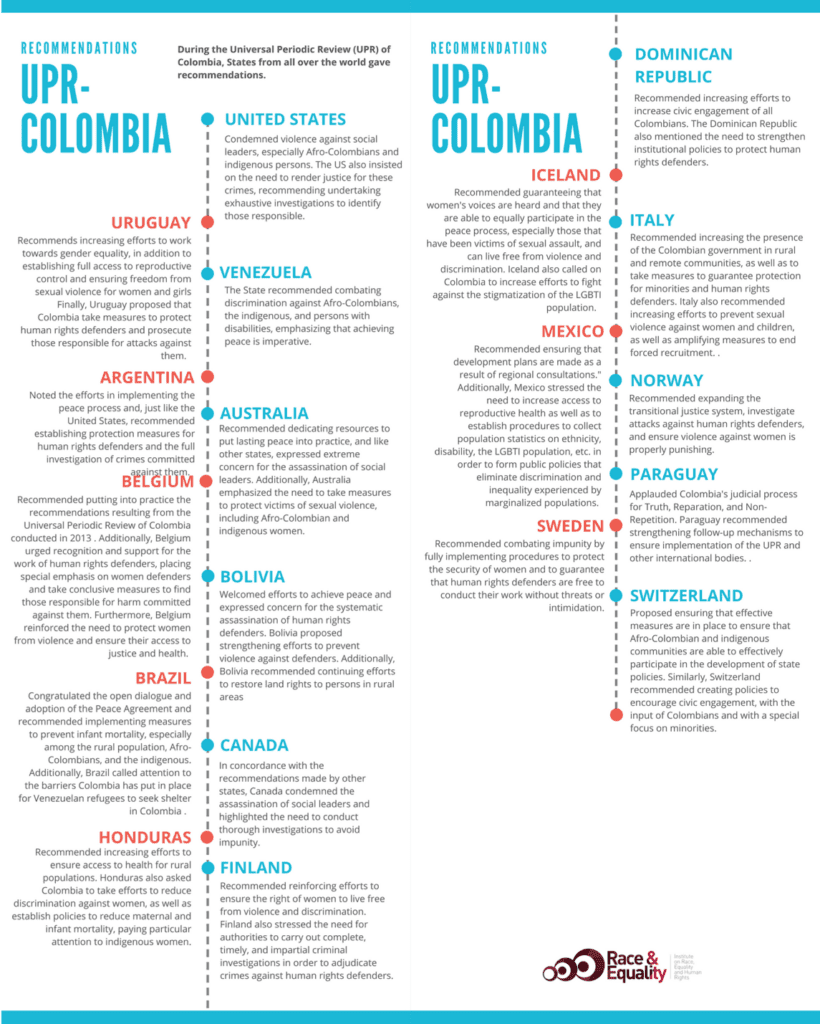
 

Race and Equality hopes these recommendations will be significantly taken into account by the State when taking measures to protect the lives of social leaders and recognize the rights of Afro and indigenous communities, men, women, children, and the LGBTI population. The Colombian government must not wait to take action to reduce violence and human rights violations. The stable and lasting peace proposed in the peace agreement has not yet been achieved in the country.
VIDEO: Afro-Peruvian women present discrimination cases before the Committee on the Elimination of Racial Discrimination (CERD)

Two afro-Peruvian women activists presented the current situation of racial discrimination they, and others in Peru live, to the Committee on the Elimination of Racial Discrimination (CERD) during its 95th session. Cecilia Ramirez of the Center for the Development of Black Peruvian Women (CEDEMUNEP) exposed the many challenges she faces, as well as giving a number of recommendations to the Committee in the video that follows:

Likewise, Azucena Algendones bared with the Committee her difficult experience of discrimination suffered in the workplace. The case is currently being processed in court, becoming the first public denouncement of its kind to undergo judicial processes in Peru. Despite the many challenges she faced in advocating for her rights – including the lack of mechanisms available to Peruvians to denounce these violations – Azucena remains committed to continuing advocating for her rights and the rights of all men, women and children victims of racial discrimination.

Inter-American Forum against Discrimination: Afro-descendant movement demands OAS member states to ratify the Inter-American Convention Against Racism and the creation of a Permanent Afro-descendant Forum at the OAS

The Institute on Race, Equality and Human Rights (Race and Equality), together with the Network of Afro-Latino, Caribbean and the Diaspora Women (Red de Mujeres) and the Center for the Development of Black Peruvian Women (CEDEMUNEP), hosted the Inter-American Forum against Discrimination on April 9, in preparation for the VIII Summit of the Americas being held in Lima, Peru. Over 60 activists from the region including from Mexico, Honduras, Cuba, Bolivia, Panama, Colombia, Uruguay, Brazil and Peru, exchanged experiences on the participation of afro-descendants in the Summit process, and in other activities at the Organization of American States (OAS).

The objectives of the Forum were to promote the effective participation of afro-descendant organizations in the VIII Summit of the Americas, to better understand the situation of racial discrimination facing the afro-Peruvian population, and to present a report on the situation of Afro-descendants in the region as a whole.

Margarette May Macaulay, President of the Inter-American Commission on Human Rights (IACHR), and Rapporteur on the Rights of Afro-descendants and against Racial Discrimination, began the Forum by stressing the important need for afro-descendant civil society in the region to pressure their respective States to ratify the Inter-American Convention Against Racism, Racial Discrimination and Related Forms of Intolerance. The President, while at the same time, was self-critical of her own entity and asked the participants to demand that the IACHR incorporate greater ethnic diversity within its internal governance.

Two women from the Red de Mujeresnetwork, Vicenta Camusso and Paola Yañez, presented the report on the “Situation of Afro-descendant Persons in Latin America and Policy Challenges to Guarantee their rights”; developed with the support, among others, of the Economic Commission for Latin America and the Caribbean (CEPAL) and the UN Population Fund Regional Office for Latin America and the Caribbean (UNFPA). The report findings showed that afro-descendant men and women of the region are largely disadvantaged across multiple social indicators, with respects to the non-afro population. According to the study, “poverty, illness, the lack of education, security and opportunity have established themselves within the roots of structural racism”,  stated Ms. Camusso. Also discussed in the report was the importance of giving accurate statistics on the Afro-descendant population in the region – a process which was initiated with census rounds in 2010.

In addition to the report, Antonio Quispe and Alex Arguedas of the Afro-Peruvian movement spoke about Afro-Peruvians’ political participation in the development of Peru and gave a brief overview of the history of the movement within the country.

Furthermore, Rodnei Jerico da Silva of Geledes – The Brazilian Institute of Black Women – spoke about how the Afro-descendant movement has been advancing itself more and more into the OAS agenda, and highlighted how the Afro-descendant regional movement played a vital role in the creation of the IACHR Rapporteurship on the Rights of Afro-descendants and Against Racial Discrimination. Mirtha Colon, president of the Central-American Black Organization (ONECA) also called for unity within the Afro-descendant movement to effectively combat structural racism in the continent; Alessandra Ramos, a Transgender Afro-descendant woman from TRANSFORMAR in Brazil, spoke about the importance of intersectionality when fighting against racism and Transphobia in the region.

Finally, Cecilia Ramirez of CEDEMUNEP, who was elected speaker of the afro-descendant coalition at the Summit, explained the process of participation for Afro-descendant members of the Coalition, and how a document was drafted which, in essence, demands the creation of a Permanent Afro-descendant Forum within the OAS, as well as the ratification of the  Inter-American Convention Against Racism, Racial Discrimination and Related Forms of Intolerance.

Message from Carlos Quesada – Executive Director of the Institute on Race, Equality and Human Rights (Race and Equality) – on the International Day for the Elimination of Racial Discrimination

On the International Day for the Elimination of Racial Discrimination, we must acknowledge the detrimental effect that discrimination, racism, xenophobia, and related forms of intolerance have on marginalized populations as well as on society as a whole. These forms of discrimination make it difficult for societies to be built on justice and equality. Therefore, advocating for the elimination of all forms of discrimination is necessary to promote social cohesion and the right to life and diversity of all peoples.

In our hemisphere, the problem of racial discrimination continues to manifest itself in various ways. In Colombia, the peace agreements signed with the FARC (Fuerzas Armadas Revolucionarias de Colombia) have not prevented the killings of dozens of Afro-descendant leaders in the past year alone. In Brazil, police brutality against Afro-descendant youth, as well as killings perpetrated against Afro-descendant trans women, are alarming and exist with impunity. In the Dominican Republic, the problem of structural racism against Dominicans of Haitian descent continues to increase. In Cuba, we continue to witness a complete denial of the issue of racial discrimination, as well as a brutal repression against those wanting to bring it to light. In Peru, it was not until 2017 that a national census quantified the exact number of Afro-descendants, while  in Panama there continues to be an invisibility surrounding the statistics on the problems that Afro-descendants face. These are just a few of the all too many examples.

The United Nations (UN) and the Organization of American States (OAS) have both created mechanisms of international law to combat the effects of discriminatory practices on the basis of race, gender, sexual orientation, language, gender identity, or religion. Among them is the Inter-American Convention against Racism, Racial Discrimination and other forms of Intolerance, which reaffirms States’ commitment in the Americas to the elimination of racial discrimination and the effective realization of the principle of equality within the region. Progress is being made to create legal avenues to address contemporary forms of racism, as well as to push for progressive international standards in the region that comply with the International Convention on the Elimination of all forms of Racial Discrimination. It is imperative to recognize the efforts made by States and International Organizations to protect the universal right to a dignified life and the effective realization of the principle of equality and liberty of all ethnic peoples. However, the unacceptable conditions that segregation and marginalization have caused in the region continue to manifest themselves today, through the indexes of poverty, unemployment, forced displacement. These conditions include the lack of effective public policies that guarantee the rights to education, health, and dignified life for the Afro-descendant and indigenous communities. These problems are felt especially significantly by women.

Therefore, we urgently call on international organizations and States to double their efforts and adopt the necessary measures to eradicate any and all forms and manifestations of discrimination so that the racist doctrines and hate-speech that undermine the ideals of every human society can be prevented and combatted. Likewise, we make an energetic call for States to ratify the Inter-American Convention against Racism, Racial Discrimination, and other forms of Intolerance. To date, this Convention has been ratified by Costa Rica and Uruguay. The Convention is a mechanism to advance efforts in the fight for universal respect of all fundamental human rights, as well as protect the lives of those who are currently marginalized.

The fight against racial discrimination is the responsibility of all, regardless of age, gender, religion, national or ethnic origin, sexual orientation or gender identity. Therefore, understanding the full effect of racial discrimination on men, women, young and old, boys and girls, should concern all social institutions. Understanding these effects is essential to counteract political discourses that belittle the significance and prevalence of racial discrimination and undermine the voices of marginalized populations.

The core mission of Race and Equality is to defend and promote the human rights of vulnerable populations, including populations marginalized because of their national or ethnic origin, sexual orientation, or gender identity. We commit to continue to denounce and help our partners fight against all forms of racial discrimination, wherever and however it manifests itself.

Race and Equality Presents Recognition to the President of Uruguay for the Ratification of the Inter-American Convention Against Racism

On October 30, The Institute on Race, Equality and Human Rights had the honor of presenting a recognition to the President of Uruguay, Tabaré Vázquez, for the Ratification of the Inter-American Convention against Racism, Racial Discrimination and Related Forms of Intolerance, in the Uruguayan city of Trinidad.

Álvaro Rodríguez, representing the National Afro-Uruguayan Coordination, expressed to the President the desire of Afro-Uruguayan populations “to be included in the future of Uruguay,” and that, with the ratification of the Convention, “Uruguay will be viewed as an advanced nation in the eyes of the international community.”

Carlos Quesada, Executive Director of Race and Equality, also expressed to the President the importance of the decision by the Uruguayan government to ratify the Convention, given that with this second ratification (Costa Rica was the first), the Convention will automatically enter into full force in the coming month. “Once again, the Uruguayan State reaffirms its commitment to human rights and, in this case, to the rights of Afro-descendants and Afro-Uruguayans,” Mr. Quesada stated.

Also present to congratulate President Vázquez on Uruguay’s commitment to adhere its national legislation to the Convention, was the Rapporteur on the Rights of Afro-descendants and against Racial Discrimination, of the Inter-American Commission on Human Rights (IACHR), Margarette May Macaulay. Commissioner Macaulay voiced her desire “for other States in the region to follow Uruguay’s steps to put a stop to the scourge of racial discrimination that affects millions of people in the Americas,” while also urging the President and the Uruguayan State to also ratify the Inter-American Convention against All Forms of Discrimination and Intolerance.

President Vázquez accepted the award with gratitude, and spoke of Uruguay’s commitment in the fight against racial discrimination, with the ratification of the Convention a natural step in that direction. Uruguay deposited the Instrument of Ratification on October 12, which will allow for the Convention to enter into full force in November 2017.

The recognition awarded to the President by Race and Equality was part of a series of activities organized with the National Afro-Uruguayan Coordination, which included a workshop on the Rapporteurship on the Rights of Afro-descendants (IACHR), a meeting between Commissioner Macaulay and members of the Afro-Uruguayan community from across the country, and a meeting between Commissioner Macaulay and members of Afro-Uruguayan organizations.

Race and Equality Conducts Workshop on Racial Discrimination with Afro-Mexican Women

Washington, D.C., September 13, 2015. The Institute on Race, Equality and Human Rights and the Instituto de Liderazgo Simone de Beauvoir (ILSB) organized a workshop for Afro-Mexican women on human rights and racial discrimination in Mexico City on August 24. The Institute held the event to coincide with Afro-Mexican women leaders’ attendance at the launch of the Report on Latin American Afro-Descendant Populations’ Organizations of the Ibero-American General Secretariat (SEGIB) in Mexico City on August 25.

The workshop sought to deepen participants’ understanding of human rights, specifically from an Afro-descendant perspective, as well as to support exchange between Afro-descendant groups from different regions and communities.

During the workshop, the nineteen Afro-Mexican women attending from different communities in Oaxaca and Guerrero reviewed basic human rights principle, including the right to non-discrimination. Other topics covered included the universal human rights system and the legal concept of racial discrimination as used in international law.

Two speakers from the National Council to Prevent Racial Discrimination (CONAPRED) attended, Mireya del Pino, Research and Policy Director, and Nuriney Mendoza, Deputy Director for Complaints, who informed the group about CONAPRED’s work and emphasized the importance of the complaints mechanism. When asked about the racial discrimination cases received so far, the CONAPRED representatives affirmed that very few complaints had been received to date.

Throughout the workshop many women underscored the triple discrimination they confront for being poor, Afro-descendant women. Despite this, many participants admitted that they have little understanding of how international law applies to racial discrimination. Participants also affirmed they had little awareness about the lack of systematization at the national level of rights violations against Afro-Mexican women.

The workshop is part of Race and Equality’s technical support of the Instituto de Liderazgo Simone de Beauvoir and its indigenous women’s leadership program, which seeks to help reduce inequality by strengthening indigenous women’s groups and providing them the tools necessary to become agents of change and uphold the social, economic, political and cultural rights of indigenous and Afro-descendant women.

Race and Equality hopes to continue to partner with the Instituto de Liderazgo Simone de Beauvoir to keep working to empower Afro-Mexican women to promote and protect their human rights.

Race & Equality Holds Training on Universal Human Rights System for LGBTI Organizations in Cancun, Mexico

Washington D.C., September 5, 2017. The Institute on Race, Equality and Human Rights held a workshop on the universal human rights system for members of the Red Posithiva and the Red de Mujeres Trans de México on August 29, 2017, at the Hotel Krystal Urban in Cancun, Mexico.

Carlos Quesada, Race and Equality’s Executive Director, led a workshop on the most recent international-level advances affecting the LGBTI community, including the 2011 UN Resolution on Sexual Orientation and Gender Identity, the first report on LGBTI rights by the UN High Commissioner for Human Rights – Discriminatory Laws and Practices and Acts of Violence Against Individuals Based on Their Sexual Orientation and Gender Identity – as well as the 2012 Born Free and Equal Manual.

Also discussed were regional advances made through the Inter-American Human Rights System, including resolutions on topics relating to sexual orientation and gender identity, the work of the Rapporteurship on the Rights of LGBTI Persons and the Inter-American Commission’s 2015 report: Violence Against Lesbian, Gay, Bisexual, Trans and Intersex Persons in the Americas.

Patsy Yajhana España Chan, Yucatan State Director and South-Southeast Zone Coordinator of the Red de Mujeres Trans de México, told of the constant human rights violations suffered by LGBTI persons, especially transgender women, on the Yucatan Peninsula. Given this situation, she said, the information provided in the training was vitally important, and more work needed to be done to build upon what was learned.

In addition, Robert Guzmán, Executive Director of the Red Posithiva – a network that promotes HIV awareness and testing and advocates for sexual and reproductive rights – emphasized the urgent need to report on the current human rights situation of the LGBTI population in Cancun and the surrounding area.

The workshop is part of Race & Equality’s ongoing efforts to train members of the Mexican LGBTI community, especially in the states of Yucatan and Quintana Roo, to help them defend the rights of LGBTI persons in the country.

The Institute Celebrates Inter-American Forum Against Discrimination in Cancun, Mexico

The International Institute on Race, Equality and Human Rights, celebrated the Inter-American Forum Against Discrimination on June 16 and 17 in Cancun, Mexico together with sixty Afro-descendant and LGBTI partners from Mexico and throughout the hemisphere. The Forum was held for members of civil society in advance of the 47th General Assembly of the Organization of American States (OAS) to coordinate advocacy efforts at the OAS General Assembly to promote the ratification of the Inter-American Convention against Racism, Racial Discrimination and Related Intolerance and the Inter-American Convention against all Forms of Discrimination and Intolerance.

The two-day event also sought to help Afro-descendant and LGBTI organizations to better understand the OAS and its functions, to increase the number of these organizations registered at the OAS and to better understand the human rights situation of Afro-Mexicans.

The Forum began with a reflection on the recent murder of Afro-Colombian activist Bernardo Cuero and included testimony from Erlendy Cuero Bravo, Vice-President of the Association for Displaced Afro-Colombians, on her colleague’s work and the threats faced by Afro-Colombian human rights defenders.

Margarette May Macaulay, the Inter-American Commission on Human Rights’ Rapporteur on the rights of Afro-descendants and against discrimination expressed her deep concern over Bernardo Cuero’s murder. “I hope to be present at the future hearing when the facts of his case are presented,” Commissioner Macaulay said. The Commissioner implored the Forum’s participants to strengthen their ties with the Commission and the Rapporteurship and to increase the flow of information from civil society to the Commission. She reaffirmed the Rapporteurship as a faithful ally of those fighting discrimination in the hemisphere.

Afro-Mexican leaders spoke of the pressing issues facing their communities. Sergio Peñaloza of Mexico Negro­ ­summed up Afro-Mexicans invisibility, recalling a Mexican official who said Afro-Mexicans “can be found in the archives, because they used to exist in colonial times, but not anymore.” Afro-Mexican panelists Eva Gasga, Torres discussed their efforts to increase recognition of Afro-Mexicans’ contributions as well as the challenges facing the community. Two principal initiatives were discussed: the work to improve census data collection ahead of the 2020 census—to better capture the full dimensions of Afro-Mexicans’ reality—and work to promote constitutional recognition of Afro-Mexicans at the federal level.

Recap of the Inter-American Forum Against Discrimination

Civil society members from throughout the region—representing Afro-descendant and LGBTI organizations—presented their experiences conducting advocacy work at the OAS, including work at the General Assembly and the Summit of the Americas, as well as public hearings before the Inter-American Commission, imparting lessons learned from this work and helping to expand collective knowledge of those assembled about challenges and best practices in working with the OAS.

Carlos Quesada, the Institute’s Director, emphasized the importance of the two Inter-American conventions against discrimination, as well as the importance of civil society’s understanding of the documents. “It’s not enough to ask our governments to ratify the conventions. We must become experts in their content and how to apply them,” Quesada said.

The Forum also included workshop for LGBTI participants led by Daniela Santana, Fellow at the Inter-American Commission’s Rapporteurship on the rights of lesbian, gay, bisexual, trans and intersex persons. Commissioner Macaulay also held a working meeting with Afro-Mexican leaders.

While the two-day Forum began on a somber note, reflecting on the life and death of Bernardo Cuero, it ended with encouraging news from Colombia. Erlendy Cuero Bravo informed the group that at least one of the suspected perpetrators in his death had been found and detained.

Institute Leads Training on the Organization of American States

In preparation for the 47th General Assembly of the Organization of American States (OAS) on “Strengthening Dialogue and Concertation for Prosperity,” to be held this year in Cancun, Mexico June 19-21, the International Institute on Race, Equality and Human Rights led a four-day training for Afro-descendant and LGBTI civil society leaders from across the Western Hemisphere in San Jose, Costa Rica May 2-4.  The training was focused on human rights protection mechanisms and advocacy strategies before the General Assembly of the OAS.

The participants, who came from a dozen different countries in Latin American and the Caribbean, were given an overview of the structure and function of the OAS. Institute staff and several invited presenters spoke about different avenues for civil society engagement, including through the General Assembly and the Inter-American Commission on Human Rights (IACHR). Use of IACHR thematic hearings, as well as the Rapporteurships on the Rights of Persons of African Descent and against Racial Discrimination, and on the Rights of Lesbian, Gay, Bisexual, Trans, and Intersex Persons, was highlighted.

Another topic discussed was the importance of ratification of the Inter-American Convention against Racism, Racial Discrimination, and Related Forms of Intolerance, currently only ratified by Costa Rica; and the Inter-American Convention against all forms of Discrimination and Intolerance. Once a second OAS Member State ratifies the first convention, it will enter into force. Participants discussed the importance of this convention for their anti-discrimination work, both regionally and nationally, as States Party will have to also ensure that domestic legislation adheres to the Convention’s provisions.

Catherine Pognat, Section Chief – Relations with Civil Society at the OAS, spoke to training participants during her sessions about the upcoming General Assembly, the importance of civil society participation, and the different possibilities for such participation in June. She emphasized the registration process in order to attend the General Assembly and the need to work in coalitions to make the voice of civil society heard.

Finally, the training attendees had the opportunity to work together to develop a strategy to participate in the General Assembly, highlighting non-discrimination, which will be presented during the General Assembly. Intersectional issues for Afro-descendants and the LGBTI community were discussed, as well as general human rights issues of regional importance. By the end of the training, the participants were excited and prepared to attend the General Assembly and advocate there on behalf of their organizations.

The International Institute on Race, Equality and Human Rights will also hold an Inter-American Forum against Discrimination on June 16-17 in Cancun, Mexico with the participation of Margarette May Macaulay, IACHR Rapporteur on the Rights of Afro-descendants and against Racial Discrimination, where the participants of the Costa Rica training will be able to share the strategy they developed.


The Institute Launches Report that Analyzes the First Decade of the IACHR’s Rapporteurship on the Rights of Persons of African Descent and Against Racism in Bogota, Colombia

The International Institute on Race, Equality and Human Rights held a public event in Bogotá, Colombia on April 28 to release its latest report, The First Decade of the Rapporteurship on the Rights of Persons of African Descent and against Racial Discrimination: Challenges and Opportunities. The event included participation by Margarette May Macaulay, Commissioner at the Inter-American Commission on Human Rights and current Rapporteur for Afro-descendants and on the Rights of women.

During his presentation, Carlos Quesada, the Institute’s Executive Director, recalled the build-up to the creation of the Rapporteurship, making clear that it was possible because of the active role of many Afro-descendant organizations in the region as well as the support of the Brazilian government. Mr. Quesada offered a critical perspective in his evaluation of the first ten years of the Rapporteurship. He recognized the importance of the activities it has carried out, but argued that the impact of these activities has been significantly limited by the fewer resources assigned to the Rapporteurship in comparison to others at the Commission, as well as the lack of internal political will to strengthen the institution.

Rapporteur Margarette May Macaulay concurred with this evaluation and offered several ideas aimed at identifying ways to strengthen the Rapporteurship in the medium term. One priority she identified was to consolidate and strengthen the work between the Commission, the Rapporteurship, Afro-descendant organizations in the region, and the different human rights mechanisms of the United Nations’ system. Commissioner Macaulay emphasized the centrality of Afro-descendant civil society organizations in activating and strengthening the human rights mechanisms at their disposal. She also underscored the strategic importance of the process to ratify the Inter-American Convention against Racism, Racial Discrimination and Related Forms of Intolerance (A-68) and the Inter-American Convention against All Forms of Discrimination and Intolerance (A-69).

Cecilia Ramírez of the Black Peruvian Women’s Development Center – Centro de Desarrollo de la Mujer Negra Peruana CEDEMUNEP – shared the experience of her organization using the Inter-American system to strengthen its advocacy capacity before both the Peruvian government and society. In an act of self-criticism, she called on the Afro-descendant organizations in the region to be more active in their use of the mechanisms offered by the Rapporteurship. Finally, Jader Gómez of the Black Communities Process – Proceso de Comunidades Negras PCN – made several comments on the content of the report. He noted the critical nature of the report as a positive aspect that helps to better understand the role of the Rapporteurship and to find ways to strengthen it and increase its relevance.

The panelists agreed that the Rapporteurship’s contributions to confronting the multiple problems faced by Afro-descendant communities in the Americas depends on strengthening the Rapporteurship as an institution. To achieve this, and to ensure the effectiveness of the Rapporteurship’s contributions, requires the active participation of Afro-descendant organizations and communities through the systematic use of the mechanisms offered by the Rapporteurship, as well as advocacy work to pressure the Commission to assign greater resources for the Rapporteurship’s work.

Also in attendance at the event were representatives of Afro-Colombian organizations, international aid agencies, human rights organizations, government  representatives and academics.

The Institute will continue to promote the report in other countries throughout the region in similar events and plans to hold a presentation of the report before the Inter-American Commission on Human Rights in the coming months to present its conclusions and recommendations in greater detail.

The full report in English can be found here.

Join Our Efforts

Help empower individuals and communities to achieve structural changes in Latin America.