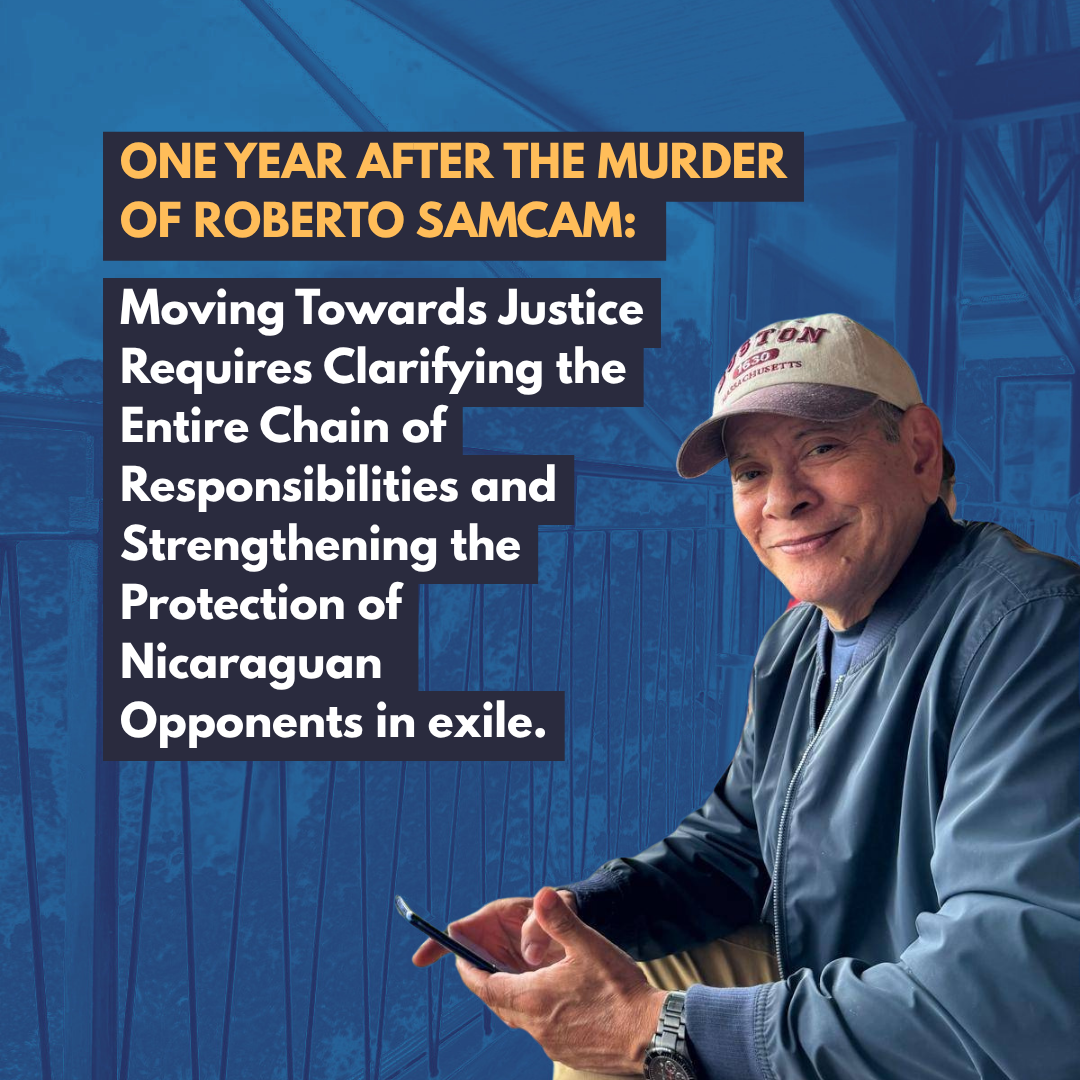
One Year After the Murder of Roberto Samcam: Moving Towards Justice Requires Clarifying the Entire Chain of Responsibilities and Strengthening the Protection of Nicaraguan Opponents in exile
Washington, D.C., June 19, 2026.– On the one-year anniversary of the murder of retired Nicaraguan Army major and Nicaraguan dissident Roberto Samcam, the Institute on Race, Equality and Human Rights […]
Washington, D.C., June 19, 2026.– On the one-year anniversary of the murder of retired Nicaraguan Army major and Nicaraguan dissident Roberto Samcam, the Institute on Race, Equality and Human Rights (Race and Equality) honors his memory and reiterates our call for this crime to be fully clarified and punished.
The murder of Samcam, perpetrated on June 19, 2025, in San José, Costa Rica, cannot be understood as an isolated event. His death occurred in a context of systematic persecution against critical voices of the regime of Daniel Ortega and Rosario Murillo, inside and outside Nicaragua. The Group of Human Rights Experts on Nicaragua (GHREN) has documented that this repressive policy transcends national borders through transnational repression practices carried out against exiles and opponents.
In its investigations, the mechanism has identified the participation of state and parastatal structures, as well as operators who coordinate surveillance, intimidation, threats, and reprisals from Nicaragua. The murder of Roberto Samcam takes place in this worrying context, which continues to put at risk the life, integrity and security of Nicaraguans in opposition or considered as such by the Ortega-Murillo regime, who live in exile.
A year after the events, we recognize as a significant advance the decision of the Costa Rican Prosecutor’s Office to present a formal accusation against the people suspected of the murder and request the opening of a trial. This step demonstrates the importance of diligent investigations and the commitment of the authorities to combat impunity in cases involving human rights defenders, political opponents, and exiles. However, the search for justice does not end with the prosecution of the alleged perpetrators.
As Roberto Samcam’s own family has pointed out, truth and justice require the identification and punishment of all those responsible, including those who planned, ordered or facilitated the commission of the crime. The determination of the entire chain of responsibility is essential for Roberto Samcam’s family to receive the justice they deserve, to avoid the repetition of similar events and to guarantee effective protection to Nicaraguans in exile who continue to be persecuted for political reasons in the countries where they sought refuge.
For this reason, we reiterate our call on the Costa Rican authorities to continue advancing in the investigations until all lines of investigation are exhausted and the facts are fully clarified. We also urge States hosting Nicaraguan exiles to strengthen protection mechanisms against the risks associated with transnational persecution.
The international community also cannot ignore the accumulated evidence on the expansion of the repressive practices of the Ortega-Murillo regime outside Nicaragua’s borders. Threats from transnational repression continue to endanger the lives, security and exercise of fundamental rights of those who have sought refuge in other countries. Ensuring the safety of exiles is an urgent obligation and an indispensable component of any effort towards truth, justice and non-repetition.
Today we remember Roberto Samcam, his commitment to democracy and his firm denunciation of human rights violations in Nicaragua. Honoring his memory also implies redoubling efforts so that this crime does not go unpunished and so that no Nicaraguan person is ever persecuted, threatened or killed again for exercising their fundamental rights.