CALL FOR PARTICIPATION: Americas Regional Forum on Conflict prevention and the protection of the human rights of minorities
CALL FOR PARTICIPATION Contextualisation There is a broad global consensus that addressing inequalities and making institutions more inclusive are central to addressing the root causes of conflicts. Most conflicts are […]
CALL FOR PARTICIPATION
Contextualisation
There is a broad global consensus that addressing inequalities and making institutions more inclusive are central to addressing the root causes of conflicts. Most conflicts are characterized by the insufficient inclusion of minorities, and, in the specific context of the Americas, indigenous peoples. Given that this is often coupled with disregard for their identities and grievances, as well as with a denial of their human rights, the main challenge now is to better understand what this means in practice.
Since 2010, the number of major violent conflicts has tripled globally, and much of the increase is in the rise of intrastate conflicts, usually involving minorities. “There are now more violent conflicts globally than at any time in the past 30 years, and the world is also facing the largest forced displacement crisis ever recorded”1.
Peace, stability and justice – in other words preventing violent conflicts – require addressing the core grievances of minorities associated with their exclusion, discriminatory practices in matters of participation in public life and other areas, accommodating their cultures, religions or beliefs, and languages, as well as other breaches of their human rights of significance to protect their existence and identities. The exclusion of and discrimination against minorities rather than ensuring their inclusion and protection in society through the implementation of their human rights, are the main root-causes of most contemporary conflicts.
Preventing conflicts requires addressing these failures in implementation. Guaranteeing the protection of the human rights of minorities, and those of indigenous peoples where they also constitute minorities, and ensuring their implementation before grievances have the chance to fester increases the chances that a conflict might not occur. These are the pathways to respect the dignity and equality of all persons to achieve justice, peace and stability as foreseen in the Preamble of the Universal Declaration of Human Rights and emergence of the international human rights system after the Second World War. The pathways for peace and conflict prevention are therefore to be found in the proper understanding and implementation of the human rights of minorities.
The full concept note for the 2021 Regional Forums is available here.
Objectives
The main purpose of the Americas Regional Forum on “Conflict prevention and the protection of the human rights of minorities” is to provide regional insights, which will feed into the thematic work of the Special Rapporteur for his report to the 49th session of the UN Human Rights Council in March 2022. Furthermore, discussions will inform the work and recommendations of the 14th session of the Forum on Minority Issues, which will take place in Geneva in December 2021.
Specific objectives include:
- Develop mutual understanding about the role of the protection of the human rights of minorities in preventing conflicts.
- Discuss legal, institutional and policy challenges to the recognition and implementation of the human rights of minorities to address long-standing grievances that may lead to tensions and possible conflicts.
- Identify why the root-causes of most conflicts, the denial of the human rights of minorities and their aspirations, are seldom acknowledged or addressed.
- Strengthen partnerships among various stakeholders and build capacity to address the root-causes of contemporary conflicts and more effectively prevent conflicts.
Date and Venue
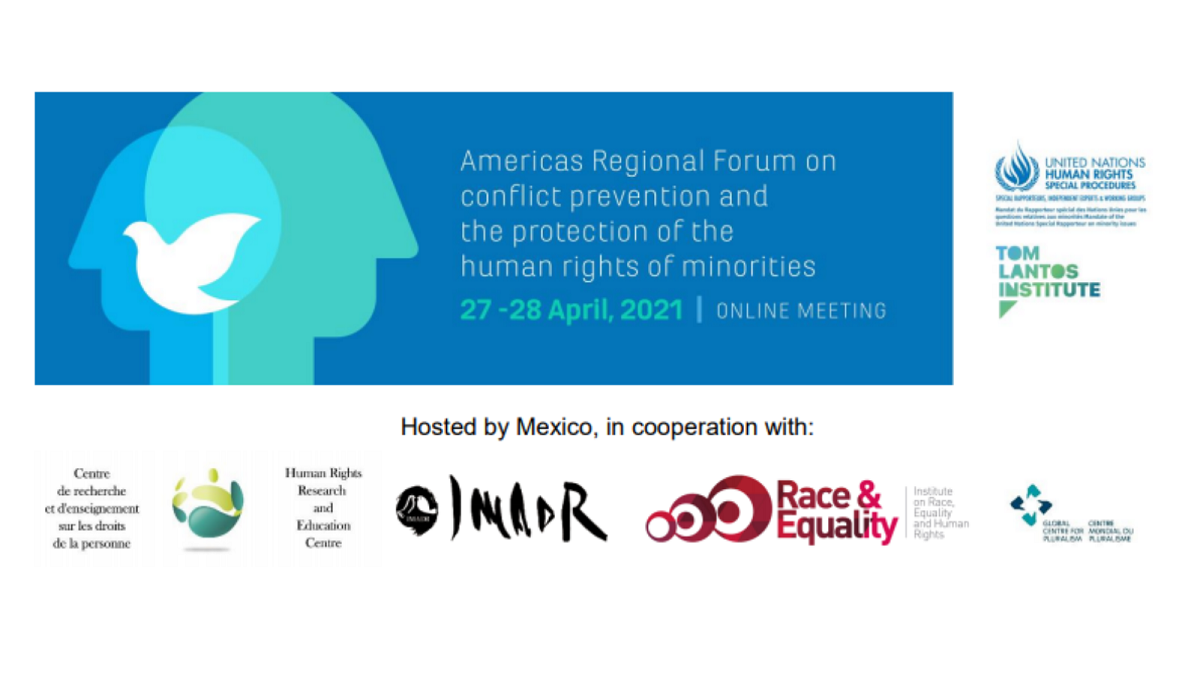
Date: 27th – 28th April 2021
Online Meeting
Participation
The Americas Regional Forum shall be open to the participation of states; intergovernmental organizations including United Nations agencies and mechanisms; national human rights institutions and other relevant national bodies; academics and experts on minority issues; representatives of minorities as well as civil society organizations specializing in minority issues.
Participation is open to individuals involved in minority issues in the Americas region (see list of eligible countries here), and with a clear focus and expertise on conflict prevention and minorities.
All individual participants must register online here. Registration will close at 11pm CEST, Wednesday 21st April 2021.
Participants are encouraged to submit any proposed recommendations in advance of the Americas Regional Forum to regionalforum@tomlantosinstitute.hu. In the event that proposed recommendations are written in French, Portuguese or Spanish, the organizers ask that these be submitted by Friday 23rd April, so that they can be translated. All written recommendations submitted in writing are collated and considered as part of the final set of recommendations developed during the regional forum.
The Americas Regional Forum will be a virtual event.
The Government of Mexico has graciously accepted acting as host for the regional forum.
Further details for joining the meeting will be sent following confirmation of registration, a few days before the event.
Areas of Discussion
In light of the main objectives of the regional forums, the discussions will address the following overarching themes. These will be informed by the framework of international human rights law and standards:
- Substantive root causes of contemporary conflicts involving minorities
- Normative framework: the human rights of minorities and conflict prevention
- Obstacles to implementing the rights of minorities and early effective conflict prevention
- Ways forward towards addressing gaps in human rights mechanisms to protect minorities and prevent conflicts
The importance of including gender perspectives in conflict prevention activities has been increasingly recognized in recent years. Therefore, discussions will take into account gender and the role of women in relation to conflict, and sexual orientation and gender identity as well as their specific intersection with minorities.
In addition to the four thematic panels, the regional forum will also include a high-level state panel consisting of several state presentations. This will highlight the positive experiences and lessons learnt by states that have been involved in conflict prevention activities, deepening the understanding about the role of the protection of the human rights of minorities in preventing conflicts.
Outputs
Based on the discussions and the contributions of the participants, the main output produced from the Americas Regional Forum will be a document with practical recommendations reflective of regional contexts and challenges.
Working language of the forum is English. Interpretation will be provided in French, Portuguese, Spanish and Mexican sign language.
1 UNHCR, Global Trends,13